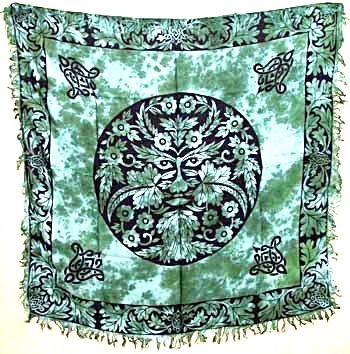
The name “Green Man” is younger than most people expect. Lady Raglan coined it in 1939, in an article for the journal Folklore about the leaf-faced carvings she kept finding in English churches. The faces themselves go back much further, and they’ve been waiting on altars ever since.
What you get
One square altar cloth, 36 x 36 inches, with fringed edges. The design is printed in black on a hand tie-dyed green ground. Because each cloth is dyed individually, the mottling and shade on yours will differ from the photograph, and no two match exactly. The cloth comes folded and is ready to use.
At 36 inches it covers a full-size altar or side table with room to drape over the edges. It also works as a tarot or rune casting cloth with space for large spreads, or as a small wall hanging.
About the design
The central medallion shows a foliate head: a face built from leaves and blossoms rather than one wearing a crown of them. Kathleen Basford’s 1978 study of the motif sorted Green Men into three types. There is the foliate head, the disgorging head with vines pouring from the mouth, and the “bloodsucker,” with foliage sprouting from the eyes and nose. This one is the first type. A border of scrolling leaves frames the field, and a knotwork panel anchors each corner.
Provenance & tradition
Leaf-masks appear in Roman decorative art. The motif then shows up in Romanesque and Gothic church carving across Europe from roughly the 11th century on, in roof bosses, capitals and misericords. Whatever those medieval carvers believed about the face, they left no written explanation.
The idea of the Green Man as a pagan god of vegetation is a 20th-century reading that started with Raglan’s article. Modern Pagans have taken it up wholeheartedly. Today he stands for the green world’s death and return, the spirit of growing things, and the wild intelligence of the forest. He sits comfortably alongside Cernunnos, Freyr, Pan and other gods of the land and the harvest.
The corner knots come from a different lineage: Insular interlace, the art of the 7th to 9th century manuscripts and carved stone crosses of Ireland and Britain. Putting continental church foliage together with Insular knotwork is a modern design choice. The two belong to different centuries, and they look good side by side.
Who this is for
This cloth suits:
- Pagans, Wiccans and Heathens building a nature or land-spirit altar
- Anyone dressing an altar for Beltane, Midsummer or the harvest sabbats
- Tarot and rune readers who want a large casting surface
- Gardeners and green witches
- Anyone who wants a gift for someone whose spirituality lives outdoors