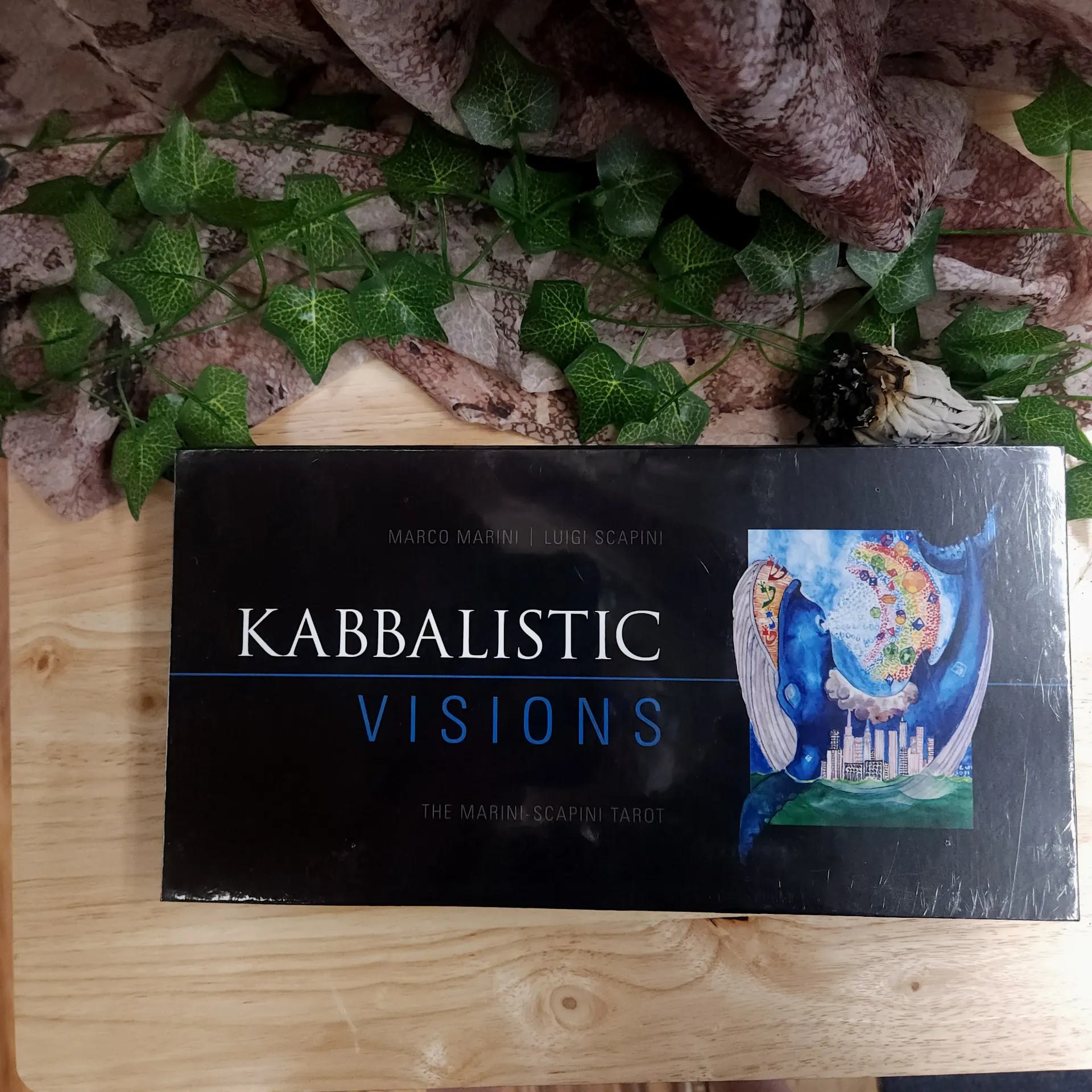
Kabbalistic Visions: The Marini-Scapini Tarot
Marco Marini, illustrated by Luigi Scapini · Schiffer · ISBN 9780764346620
The companion volume runs 256 pages, and there's a Tree of Life map in the box alongside it. Every one of the 78 cards carries a Hebrew letter worked into the image, which means the correspondence you are studying is on the card in front of you rather than looked up in an appendix. This is a study set that happens to be beautiful.
What you get
- 78 cards: 22 Major Arcana, 56 Minor Arcana with full courts
- Card size: 3¼ × 5¼ inches
- 256-page companion guidebook
- Tree of Life map
- Rigid box, approximately 11¾ × 6 × 1¾ inches
- Weight: 2.23 lbs
- Complete and ready to study out of the box
About the deck and the art
Luigi Scapini paints in watercolor, and the work here is loose, saturated, and strange in the best way. Figures dissolve into landscape. Scale shifts mid-image. A whale carries a city on its back. The compositions are built to hold symbol density without turning into diagrams.
Alongside the Hebrew letters, the cards carry astrological, elemental, and numerical markers. The guidebook gives full overviews of the tarot structure, the Hebrew alphabet, and the Tree of Life glyph before it gets to card meanings, plus spreads keyed to position: past, present, future, obstacles, outcome.
The imagery is dense enough that it rewards slow work. This is a good deck for a single daily card and a notebook, and a demanding one for fast three-card readings.
Provenance and tradition
Marco Marini has taught Kabbalah for over twenty years and writes on tarot, astrology, and archetypal symbolism. Luigi Scapini is an Italian painter working in sacred art with academic appointments, and he has produced fifteen tarot decks distributed internationally, including the Medieval Scapini Tarot, which has been in continuous print since the 1980s and is on a great many serious readers' shelves already.
Kabbalah is a living Jewish mystical tradition with its own textual lineage running through the Sefer Yetzirah, the Zohar, and the Lurianic schools of sixteenth-century Safed. The system that maps the 22 Major Arcana onto the 22 Hebrew letters and the paths of the Tree is a later European development: Court de Gébelin proposed an Egyptian origin for the tarot in 1781, Éliphas Lévi made the letter-to-trump assignments explicit in the 1850s, and the Hermetic Order of the Golden Dawn systematized what most readers now use. That stream is usually spelled Qabalah or Cabala to mark it as distinct.
Who this is for
Readers ready to move past keyword meanings into structural correspondence work. Students of ceremonial and hermetic practice who want the Tree material presented with images rather than tables. Collectors of Scapini's work. Anyone who wants one boxed set that will occupy them for a year. Meditation and pathworking, where the density of a single card enhances the practice.