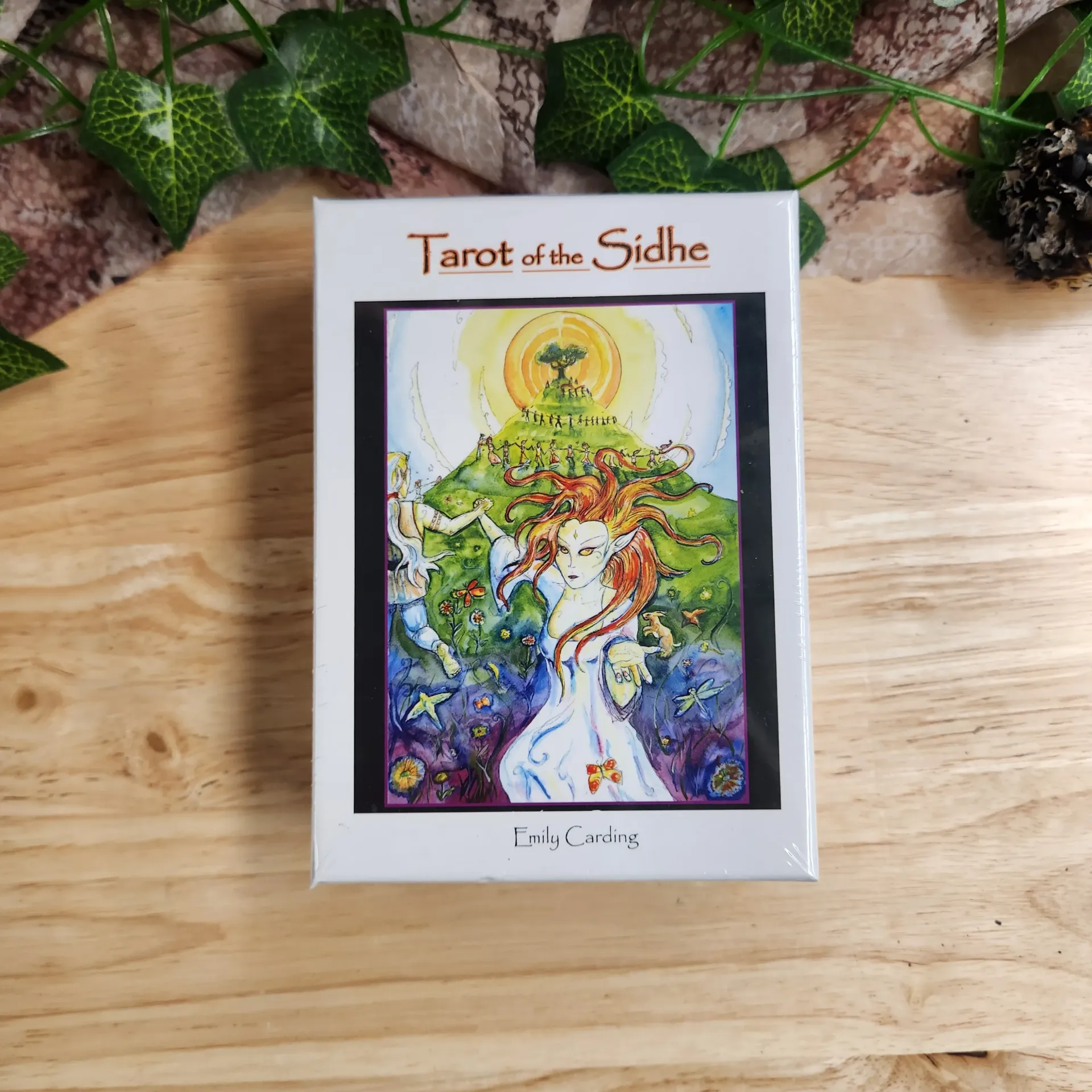
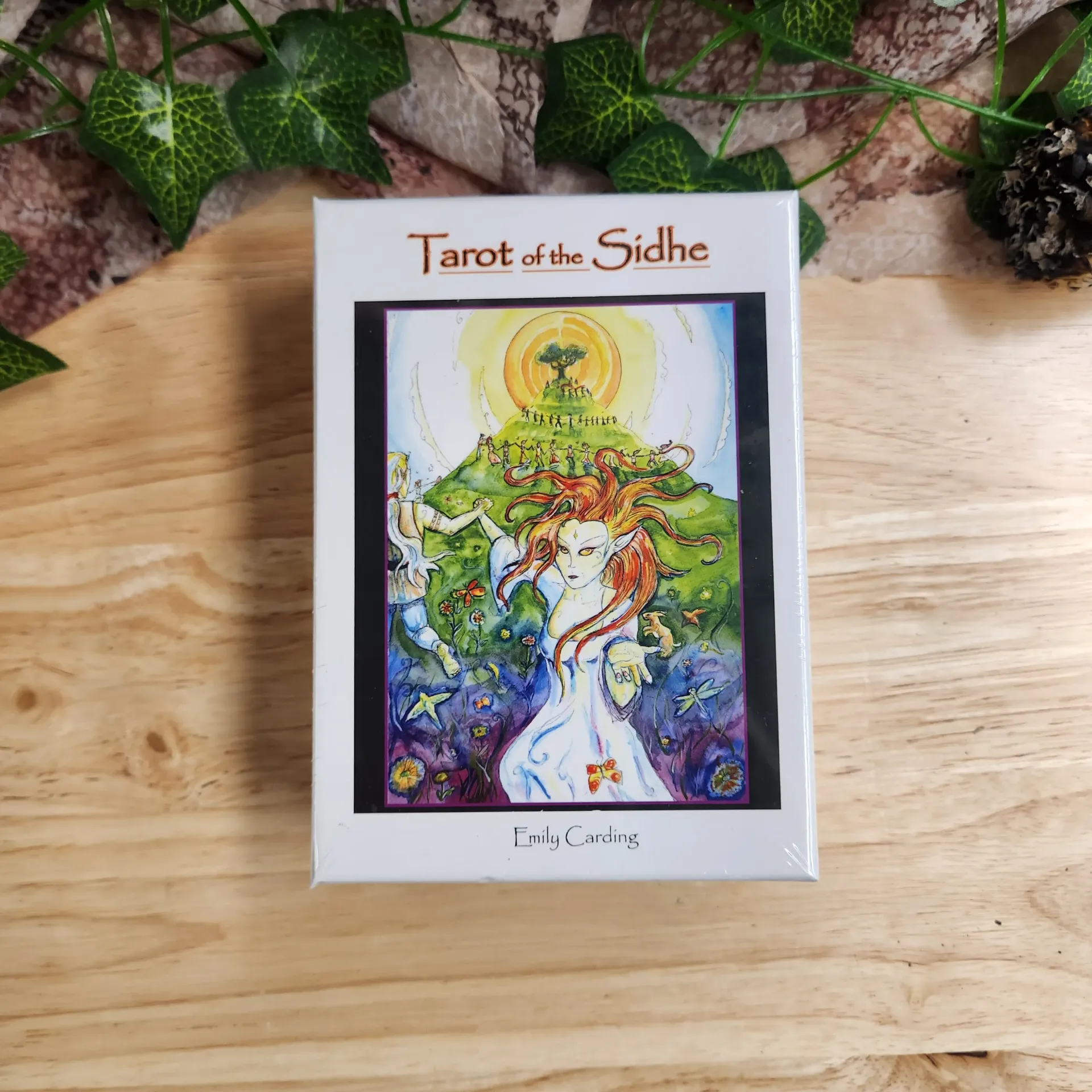
Tarot of the Sidhe — Emily Carding
These are big cards. At 3⅜ by 5⅞ inches they run considerably taller than a standard tarot, which gives the paintings room to work and makes a full riffle shuffle awkward if you have small hands. Overhand or pile shuffling handles them comfortably.
What you get
- 78 full-color cards, 3⅜" x 5⅞"
- 96-page guidebook with a foreword by Celtic folklorist John Matthews
- Rigid box with lift-off lid, 3.75" x 5.25"
- New, factory sealed
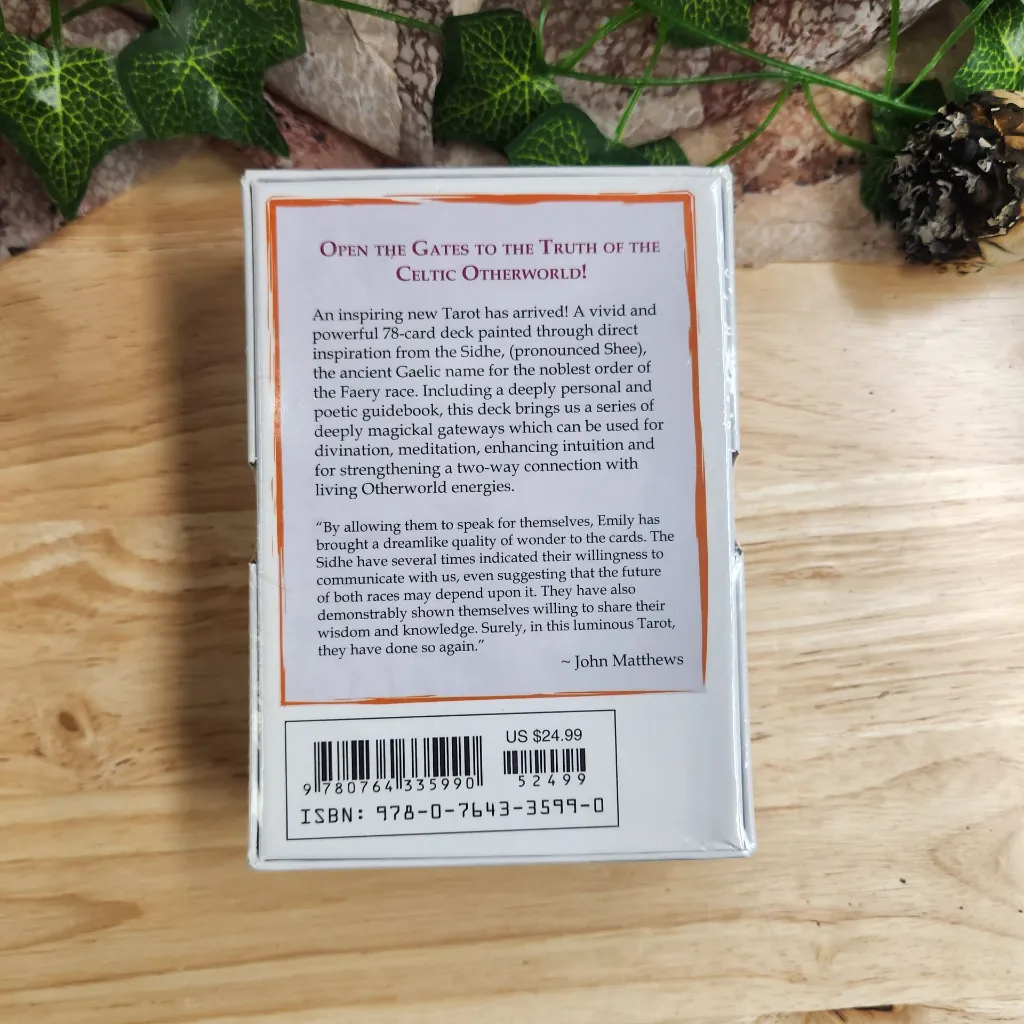
- ISBN 9780764335990, Schiffer Publishing, 2010
- Shipping weight 0.92 lb
About the deck
Emily Carding painted this deck as received work rather than as an illustration project, and the structure reflects that. It holds the traditional 78-card skeleton with two Major Arcana renamed: the Hierophant becomes the Elder, and the Devil becomes Pan. Justice sits at VIII and Strength at XI, following the older ordering rather than the Rider-Waite-Smith swap.
The four suits are renamed for what they do. Dreamers carry the air and intellect material, Warriors the fire, Dancers the water, Makers the earth. Courts are King, Queen, Prince and Princess in the Golden Dawn pattern rather than Page and Knight. Every numbered card prints its suit and number across the top and a keyword or phrase across the bottom, so the Nine of Dreamers reads as Nightmare and the Two of Makers as Responsibility. Card backs are solid black with the Great Glyph of the Sidhe in grey, and they are not reversible.
The pip imagery is original rather than derived from Rider-Waite-Smith. The printed keywords do a lot of the work in its place, which makes the deck more approachable than its reputation suggests. Readers who want their usual visual shorthand should know it's a genuine re-learn.
In the guidebook, each Major Arcana card speaks in its own voice alongside keywords and artist notes, while the pips and courts each carry a short poem and keyword list. Every card is reproduced in the book. It closes with three spreads (a six-card Pentagram for career, a seven-card Hexagram for relationships, an eight-card Septagram for the whole self), a meditation for entering a card and meeting what lives inside it, and a poem, "Song of the Sidhe."
Provenance & tradition
Sidhe is pronounced "shee." In Old Irish, síd names the mound itself, the hollow hill; aos sí, the people of the mounds, are named for where they live. The box copy calls it the Gaelic word for the faery race, which is how the term ended up in English usage, though the older sense points at the barrow first and the inhabitants second.
Carding is a self-taught artist, writer, priestess and actor, based in England, whose other work includes the Transparent Tarot and Transparent Oracle for Schiffer and Faery Craft for Llewellyn. This deck was made through visionary and shamanic practice. John Matthews's foreword lends folklorist standing to the project, and the deck itself remains one person's received material rather than a reconstruction of documented Irish or Scottish tradition.
Who this is for
Readers doing faery work, Otherworld contact, hedge-crossing or land-based practice. Anyone wanting a deck for meditation and journeying rather than quick predictive spreads. Collectors of independent visionary decks, and readers who already own the classics and want a different set of doors. Beginners can work with it thanks to the printed keywords, though a Rider-Waite-Smith deck teaches faster if learning the standard system is the goal.