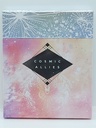
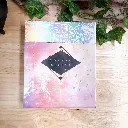
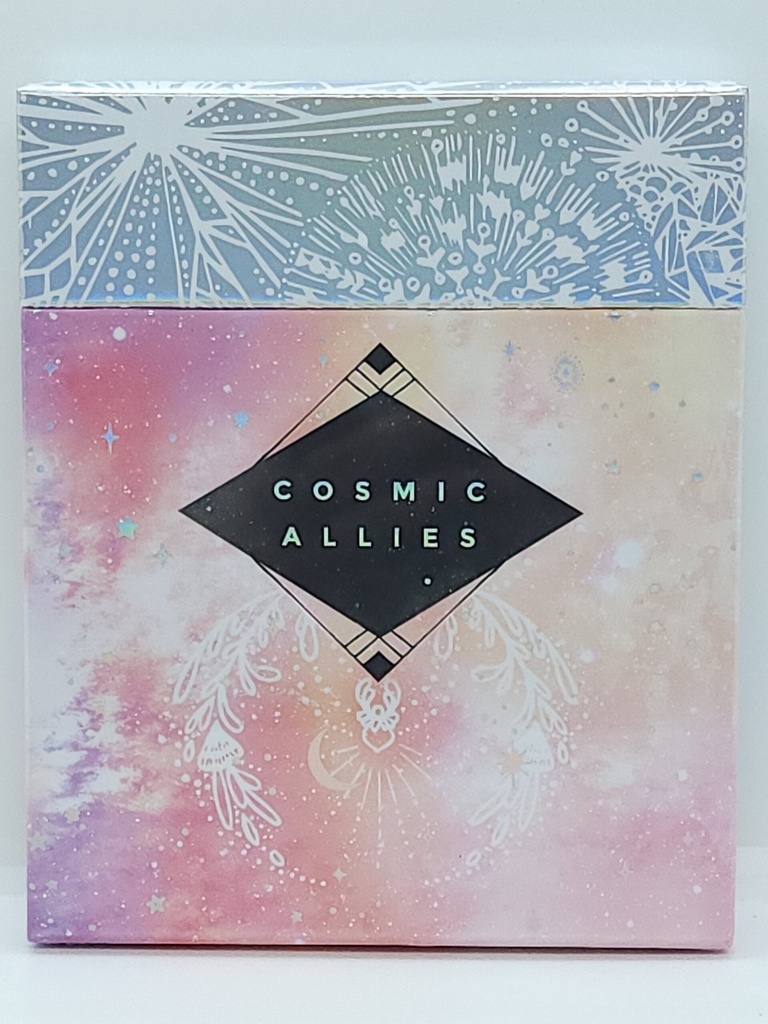
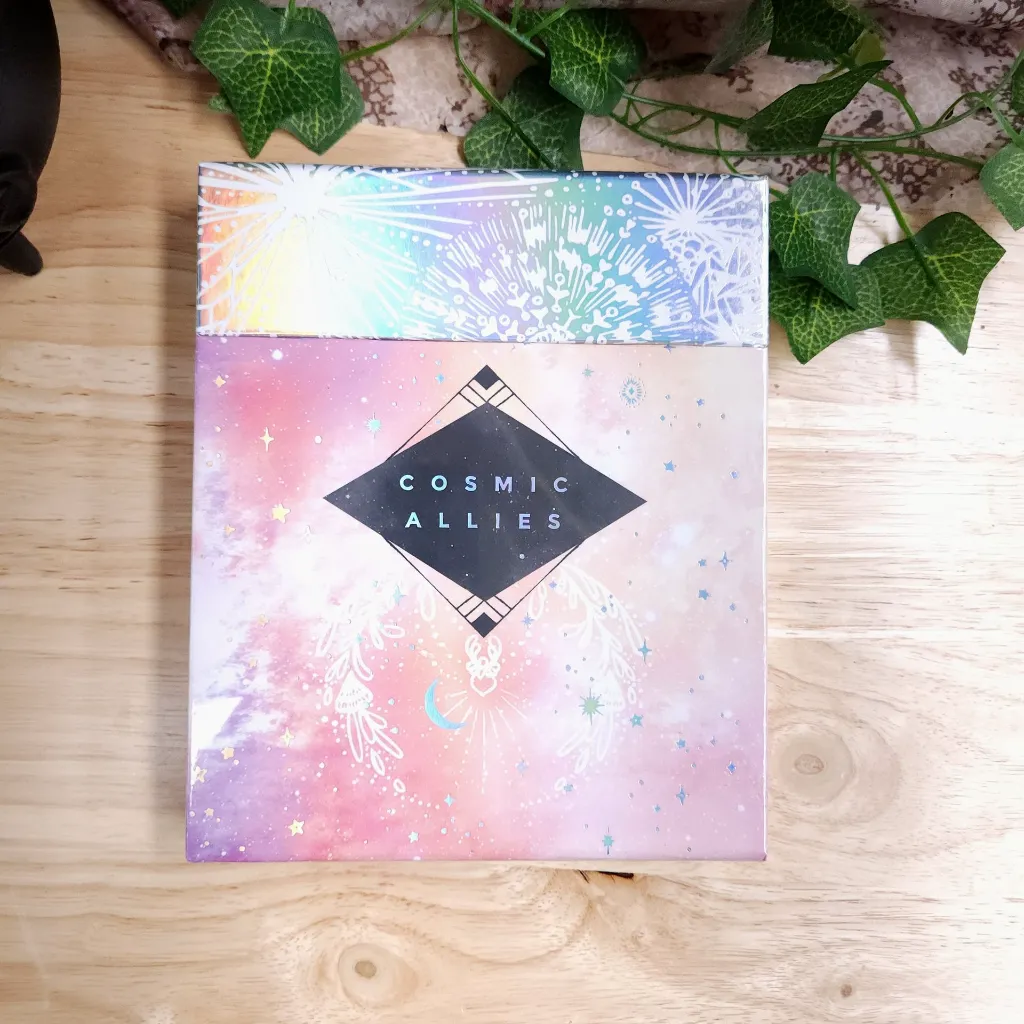
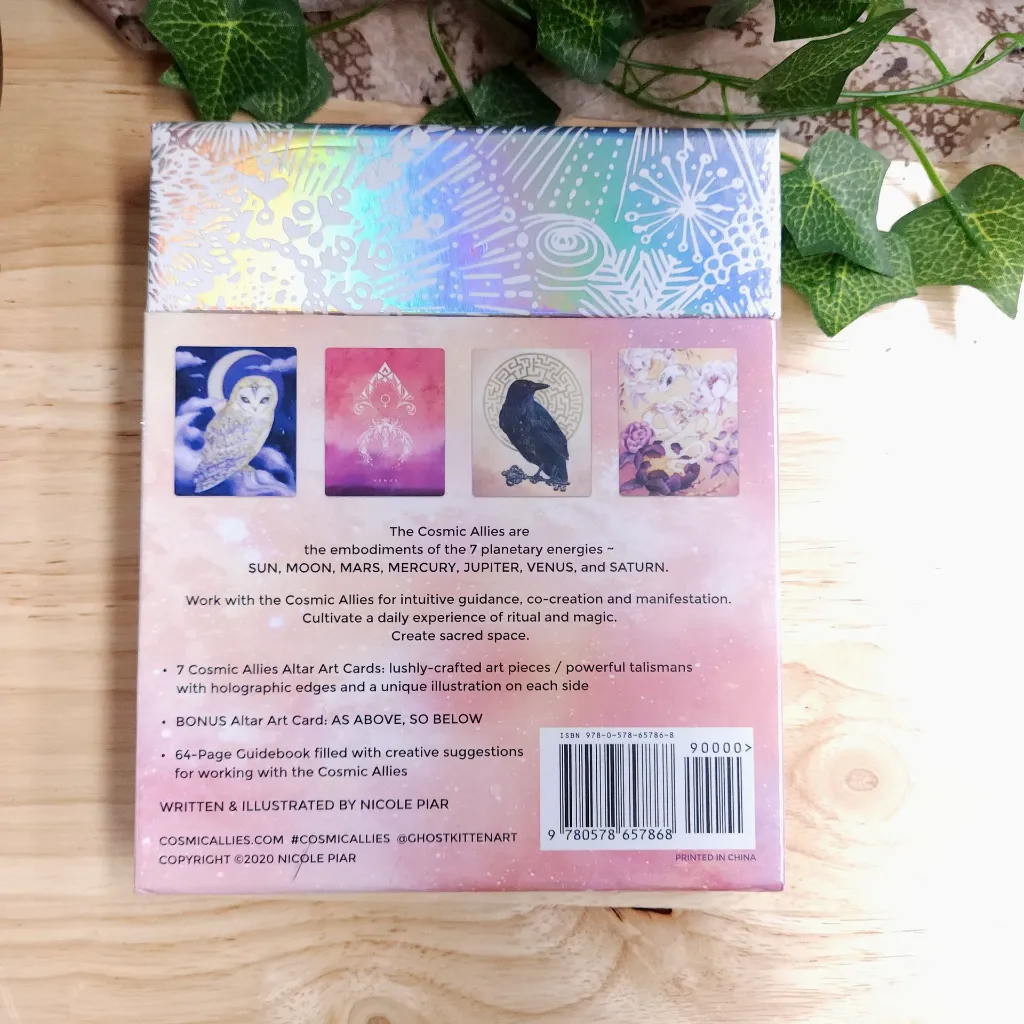
Cosmic Allies Altar Art Deck & Book
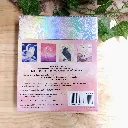
Eight cards at 5 by 6.25 inches — roughly two and a half times the footprint of a standard tarot card — printed on double-thick matte stock with holographic gilded edges, each side carrying a different full illustration. The stock is rigid enough that a card stands unsupported against a wall or in a stand. That is the design intent: these are made to be displayed and rotated rather than shuffled.
What you get
- 7 Cosmic Allies altar art cards, one for each of the seven classical planets: Sun, Moon, Mars, Mercury, Jupiter, Venus, Saturn
- 1 bonus altar art card, "As Above, So Below"
- 64-page guidebook
- Rigid holographic keepsake box, 6.5 x 5.5 inches, sized to hold cards and book together
- Written and illustrated by Nicole Piar, ©2020
- ISBN 978-0-578-65786-8
- Ships at 0.73 lb
How it actually works
Eight cards is not a reading deck. There are no spreads to lay, no reversals, no daily pull in the usual sense. What you do instead is choose — by planetary day, by transit, by what you're working on — and set that card up as the visual anchor of an altar or a workspace for as long as the work runs. Fridays for Venus, Saturdays for Saturn, and so on. Each card is illustrated on both faces, so you get two distinct images per Ally and can turn the card to shift the mood without swapping it out.
The guidebook gives each Ally a full treatment: a description of the energy, affinities and associations, suggested offerings, a poetic invocation, creative prompts, mantras, and a tarot spread built specifically for that planet. Those spreads are where the set connects to a deck you already own; the Allies supply the frame, your tarot supplies the reading.
Provenance and tradition
The seven Allies are the seven classical planets of pre-Copernican astronomy — the wandering lights visible to the naked eye, which anchored astrological practice across the Hellenistic, Islamic, and medieval European worlds. Planetary talismans made for a specific power, on its day and hour, are a documented working tradition: the Ghāyat al-Ḥakīm, known in Latin as the Picatrix and compiled in Arabic around the tenth or eleventh century, is the major surviving source, and Cornelius Agrippa's Three Books of Occult Philosophy (1533) carried the material into Renaissance practice. A card made as a fixed image for a single planet sits in that lineage.
The bonus card takes its title from the Tabula Smaragdina, the Emerald Tablet, a short Hermetic alchemical text surviving first in Arabic sources and reaching Latin Europe by the twelfth century. The correspondence between celestial and earthly orders is the working premise underneath all planetary magic.
Piar states plainly in the guidebook that she isn't asking anyone to accept a particular cosmology and that the material isn't a religion — honor what resonates, leave the rest.
Who this is for
Altar builders. Astrologers who want a physical object for the planet they're working with. Practitioners running planetary-day devotions. Tarot readers looking for a frame that layers over an existing deck. Anyone who buys decks partly as art, since these are large enough to frame. It works for beginners because the seven planets are a small, learnable system, and it holds up for experienced practitioners because the guidebook material is substantive.