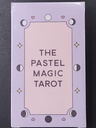
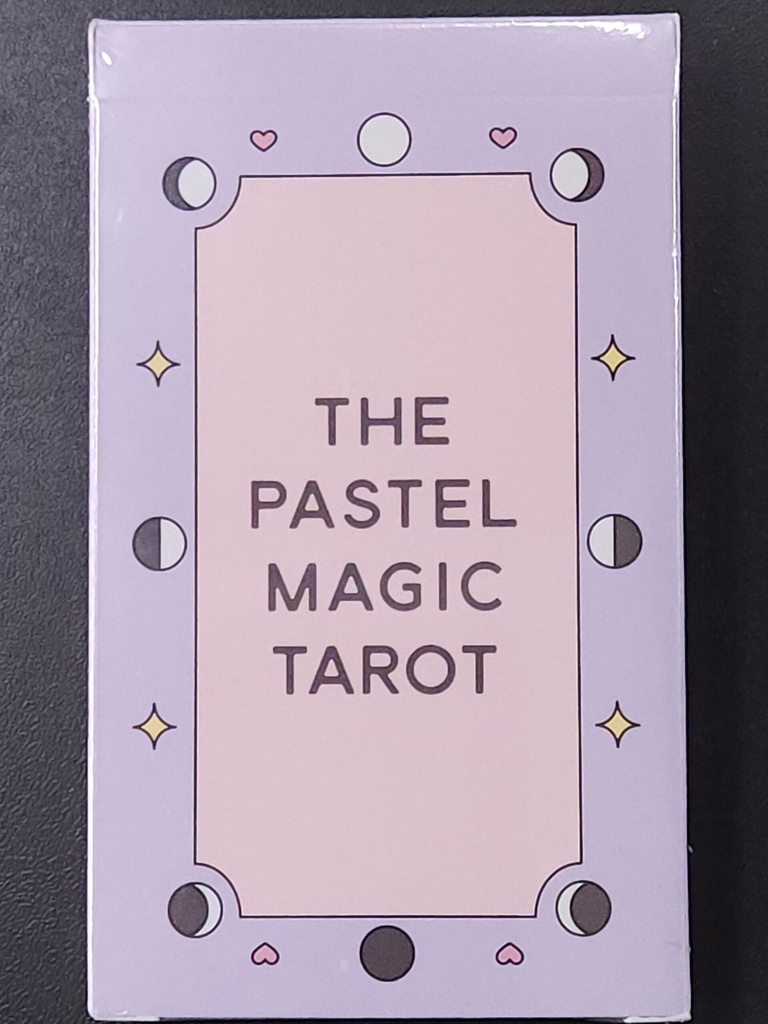
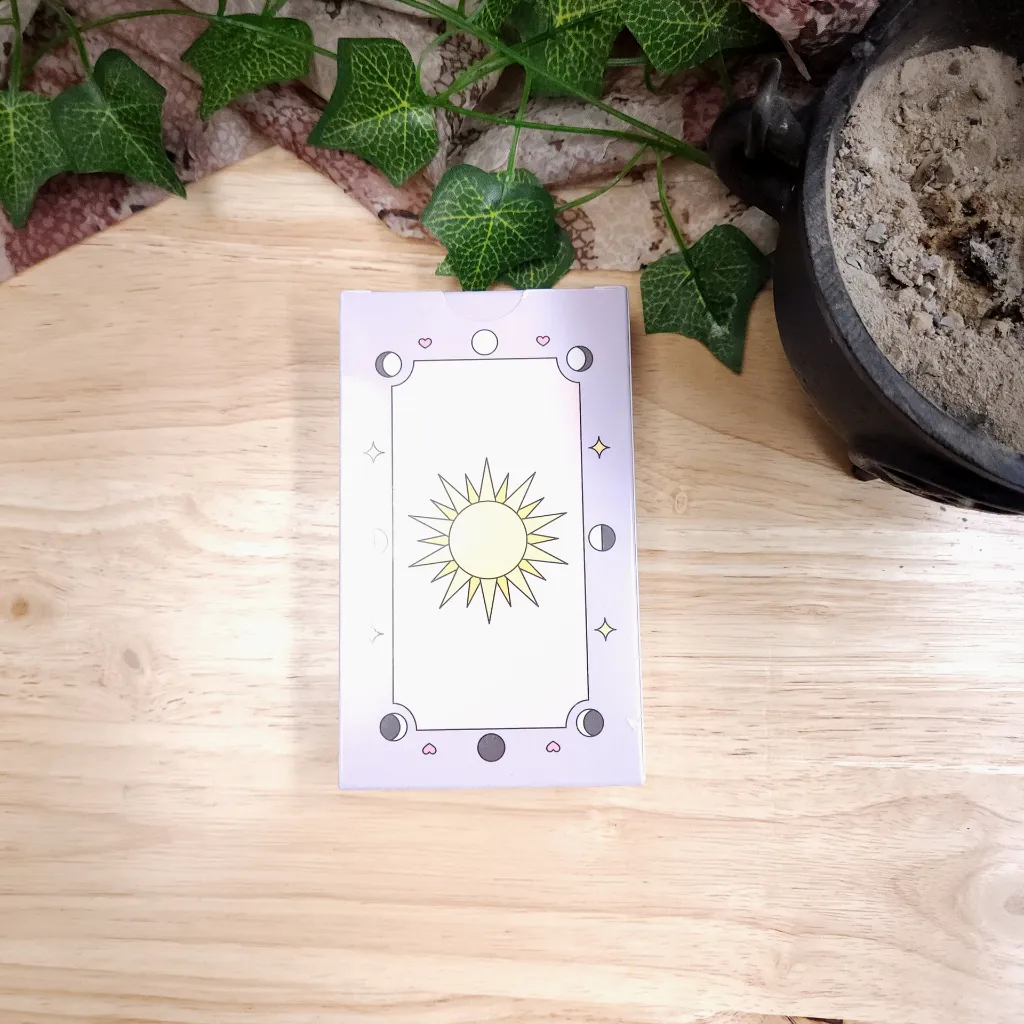
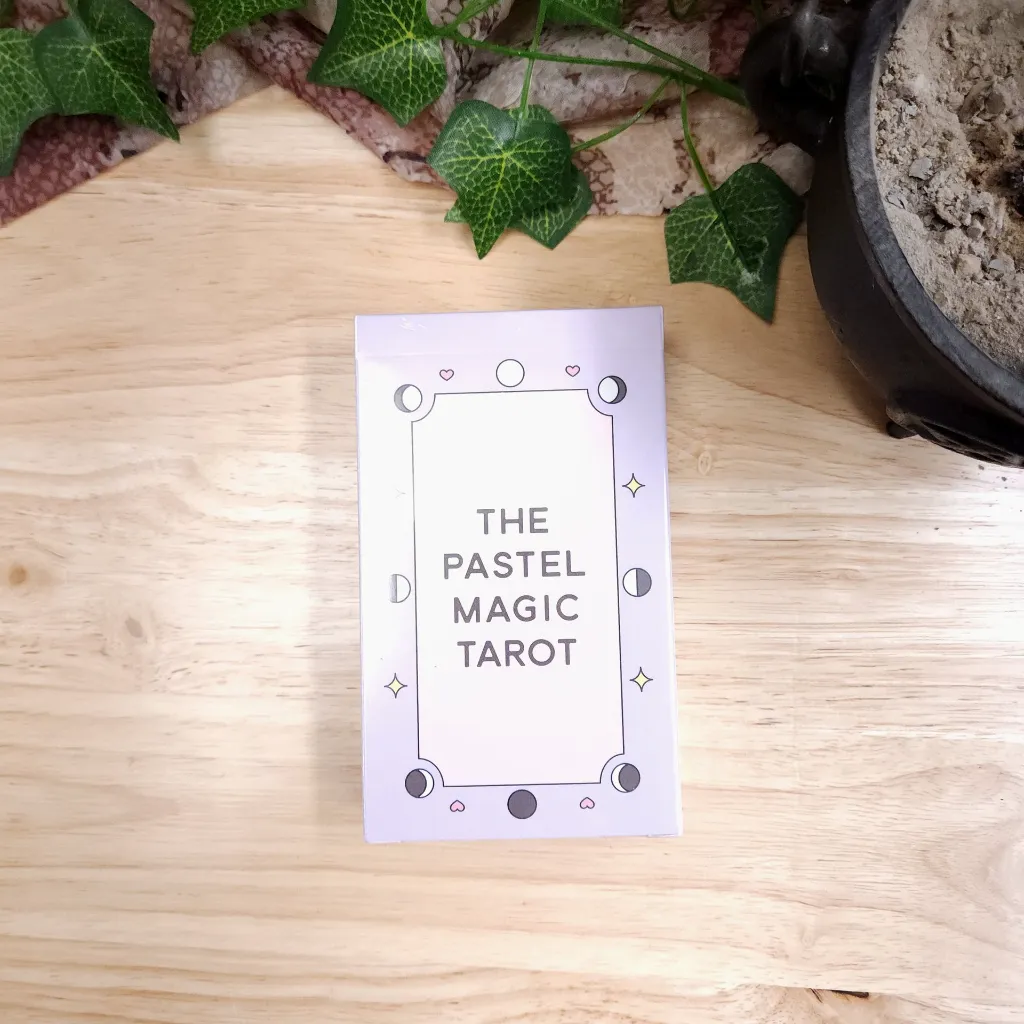
The Pastel Magic Tarot
Seventy-eight cards printed on 280gsm blue core cardstock, which is the spec worth understanding first. Blue core means an opaque layer sandwiched between the two printed faces. Hold a card up to a lamp and no image bleeds through from the other side, so a card lying face-down on the table gives nothing away. At 280gsm the cards have real body and spring back after a riffle rather than staying bent.
What you get
- 78 cards, full Rider-Waite-Smith structure: 22 Major Arcana, 56 Minor Arcana across four suits
- Card size 2.75 x 4.75 inches — slightly taller and narrower than a standard RWS card, which suits smaller hands
- 280gsm blue core cardstock
- Custom tuck box, 4.75 x 3 inches
- Ships at 0.44 lb
About the deck
The palette runs to soft lilac, blush, pale yellow, and grey, with clean linework and a lot of white space. The design strips the imagery bare: moon phases, suns, stars, simple figures, no crowded symbol fields to decode.
The minor arcana are handled pip-style — suit and number rather than a full narrative scene. If you learned tarot by reading the picture on the Eight of Cups, you'll be doing different work here, leaning on suit, number, and your own association rather than on a scene someone else composed. Readers who already work intuitively tend to find that liberating. Readers who lean on scenic minors as a memory aid will want to keep a reference nearby for the first few months.
Provenance and tradition
The Pastel Magic Tarot is the work of Maria Morales, a Pacific Northwest artist publishing under her Mulberry Moons imprint. During production she revised the Chariot and Strength cards specifically to widen the range of figures the deck depicts, and inclusivity is a stated design intent rather than a marketing afterthought.
On the pip question, a little history helps. Scenic minor arcana are a twentieth-century innovation: Pamela Colman Smith illustrated all fifty-six minors for the Rider-Waite-Smith deck in 1909, and that choice was novel enough that it reshaped how English-speaking readers learn tarot. Every deck before it — the Tarot de Marseille, the Visconti-Sforza cards, the whole Continental tradition — used pip minors. Readers worked from suit, number, and position. A modern pip deck is closer to the older convention than to the one most beginners are taught.
Morales also wrote a companion volume, The Pastel Magic Book of Tarot Spreads (ISBN 978-1-7939-4279-1), a hybrid spread book and journal built around thirty personal-development themes.
Who this is for
Readers who want a gentle deck for clients who find traditional tarot imagery intimidating. Intuitive readers who prefer fewer prescribed meanings. Anyone building a collection who wants a pastel, minimal deck alongside their heavier ones. Good for beginners with the caveat above, and a strong gift — the box and palette read as approachable rather than ominous, which matters when the recipient isn't sure how they feel about tarot yet.