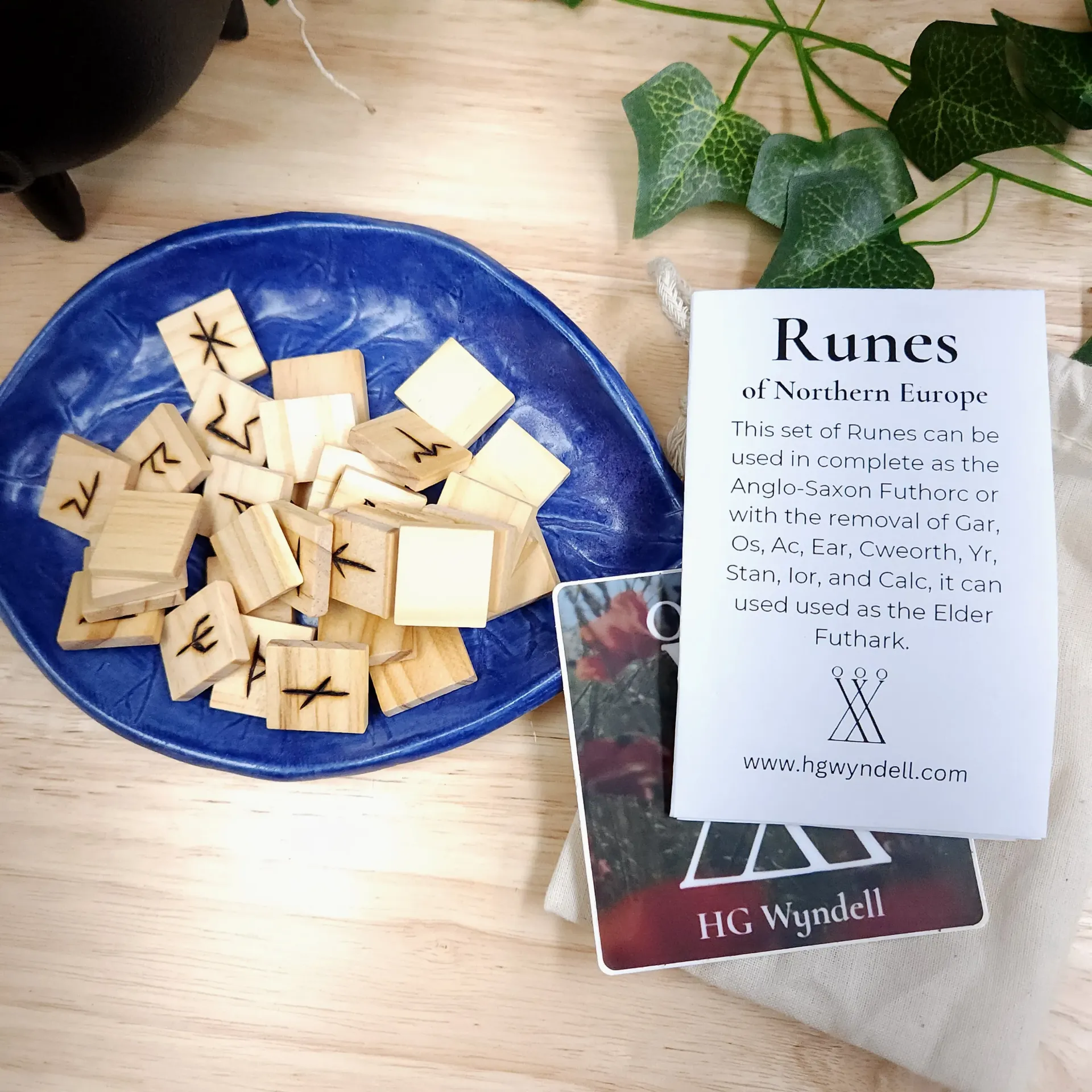
This set has the full 33 runes of the Anglo-Saxon Futhorc, burned by hand into poplar by rune worker HG Wyndell. It's the alphabet English and Frisian speakers carved from around 500 CE until it fell out of use around 1200. Most rune sets stop at the 24 of the Elder Futhark. This one gives you the whole later row, and it still works as an Elder Futhark set when you want one.
What you get
- 33 poplar rune tiles, each one hand-burned with pyrography
- Runes on one face only, so a face-down draw is a true blind draw
- Cotton drawstring pouch for carrying and storage
- Printed insert from the maker with basic information on the set
- Ships at 0.15 lb
- Ready to cast as soon as you open it
About the form
Poplar is a light, close-grained hardwood. It takes a burned line cleanly and stays easy on the hand during a long reading. Every stroke was burned one at a time, so line weight and depth change a little from rune to rune. The grain differs from tile to tile too, so your set won't match the photo exactly. Keep it dry and out of standing water, since a burned mark on bare wood can lift if the wood swells.
Provenance & tradition
The Futhorc grew out of the Elder Futhark as Old English sounds shifted away from the older Germanic ones. The fourth rune is why the name changed: the Elder Futhark's Ansuz became Os, and futhark became futhorc. Anglo-Frisian carvers added runes for new sounds, Ac, Æsc, Yr, Ior and Ear among them. Northumbrian carvers in the far north of England added four more, Cweorth, Calc, Stan and Gar, which brings the row to 33.
That history is why the set does double duty. Take out Gar, Os, Ac, Ear, Cweorth, Yr, Stan, Ior and Calc, and the 24 runes left line up with the Elder Futhark. Æsc stands in for Ansuz and Ethel for Othala, and the rest map one to one.
To read the full set, start with the Anglo-Saxon rune poem. It's the longest of the three surviving rune poems, probably from the tenth century, and the only one with verses for the runes the Norwegian and Icelandic poems leave out. The four Northumbrian runes have no verses in any surviving poem, so their meanings come from later scholarship and your own practice with them. There's no blank rune here, and there wasn't one historically either. The blank tile in most commercial sets comes from 20th-century revival writing.
Who this is for
This set is for rune readers who want the additional Anglo-Saxon runes, and for students working through the rune poems. Heathens and Northern Tradition practitioners with an Anglo-Saxon or English focus will find it fits their practice. It also suits beginners who want one set for double duty, since it can serve as an Elder Futhark as well as Anglo-Saxon.