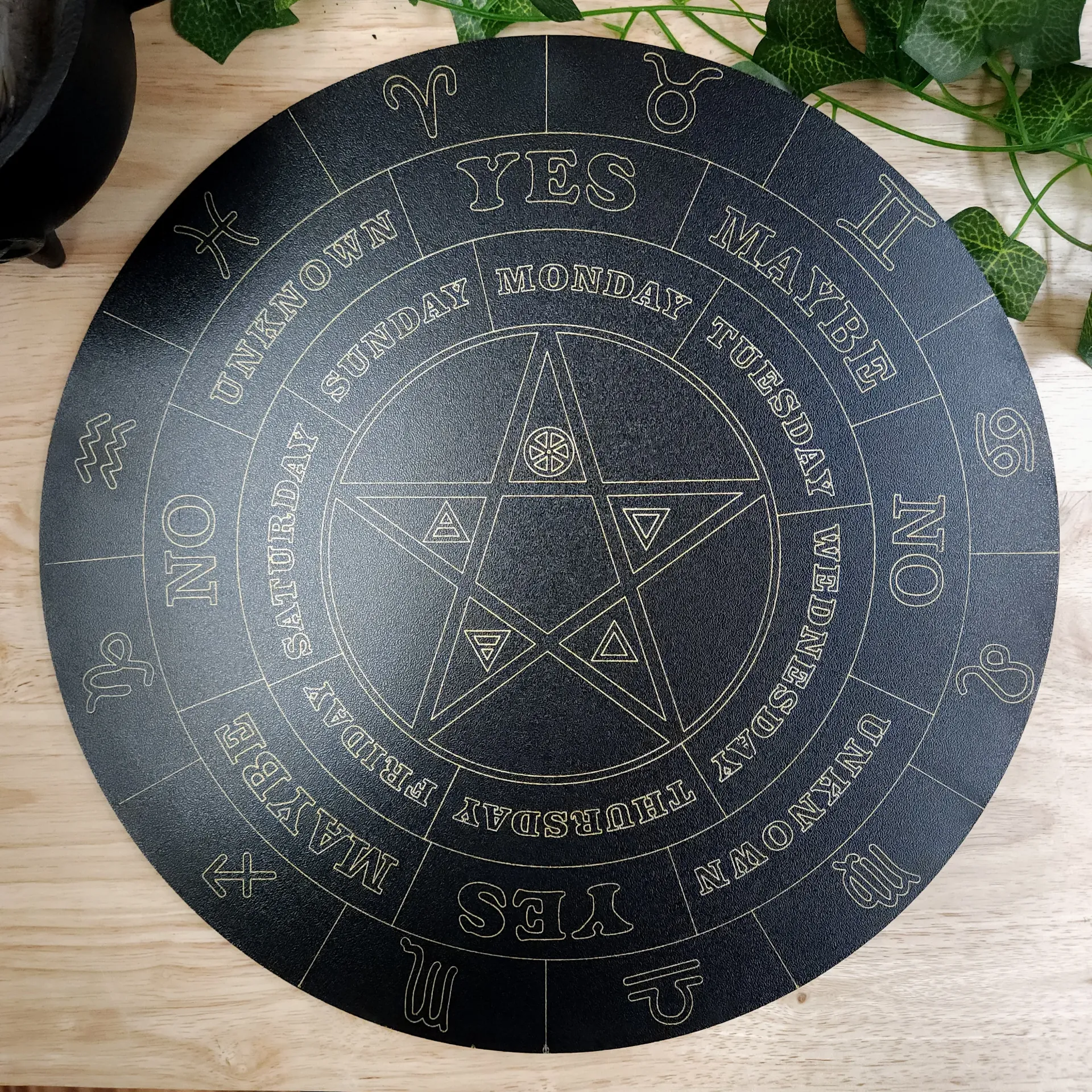
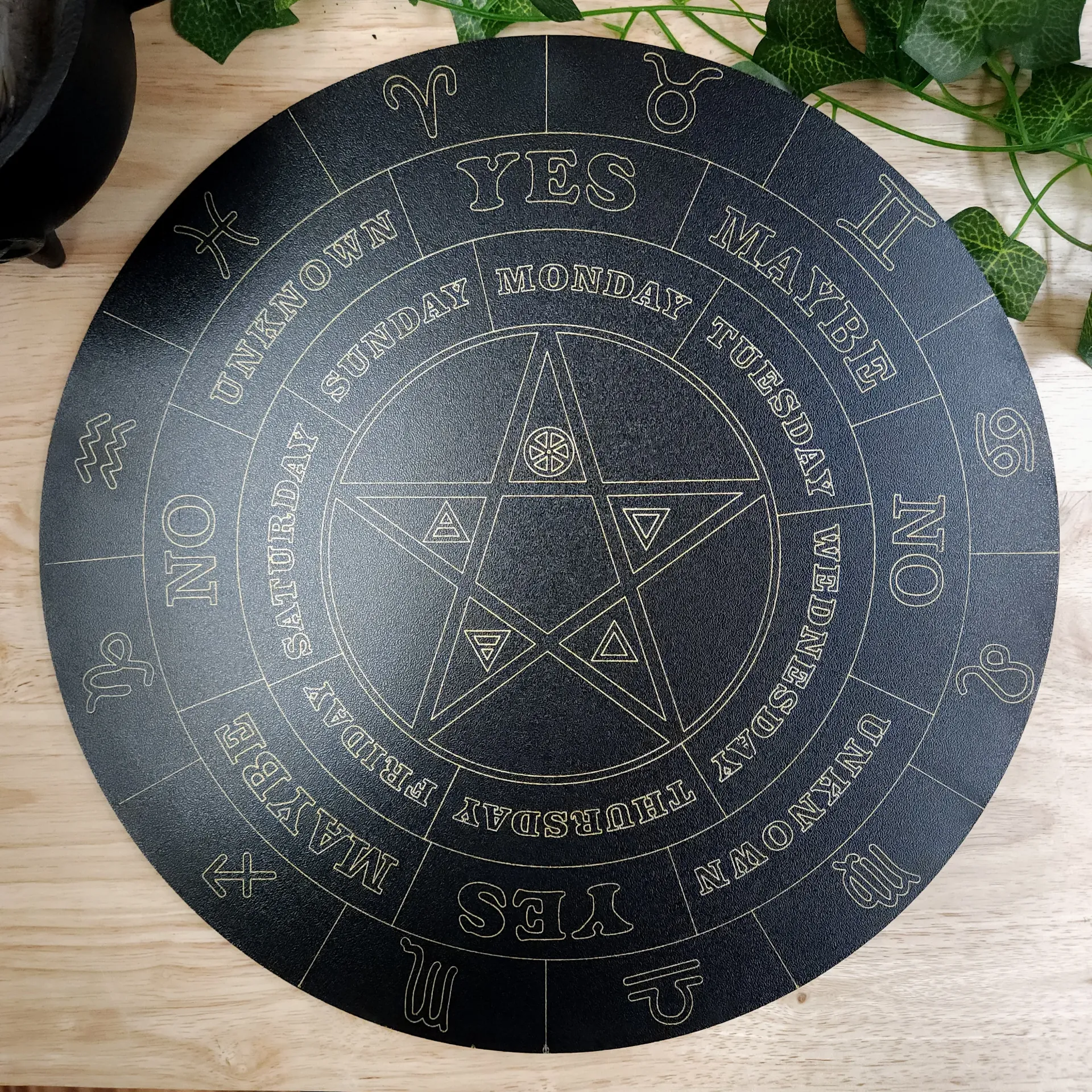
This board is built for questions about when and which, not for spelling. It has three rings. The outer ring holds the twelve zodiac signs, the middle ring holds the answer stations, and the inner ring holds the seven days of the week. The center is an elemental pentacle. There are no letters or numbers, so a pendulum can't spell words here. What it can do is narrow a question to a day, a sign, or a yes/no answer in a single swing.
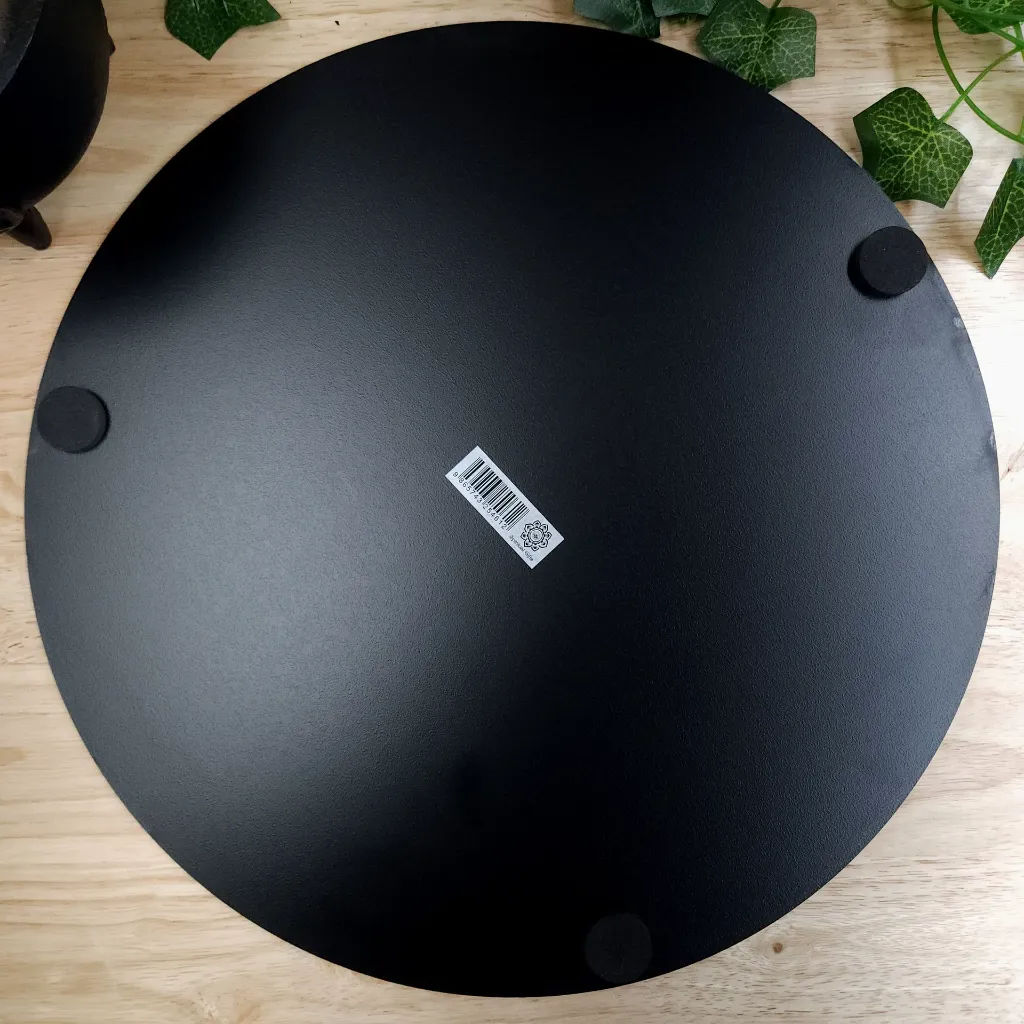
It's almost a foot across and an eighth of an inch thick, and it rests on three foam feet underneath. The feet lift it off the table, so it's easy to pick up and slide around an altar.
The answer stations sit on two axes. Yes is at the top and bottom, lined up with a toward-and-away swing. No is at left and right, along the side-to-side swing. Many people set up their pendulum that way. Maybe and Unknown take the diagonals, and each of the four stations appears twice, at opposite positions.
What you get
- One round pendulum board, zodiac and elemental pentacle design
- 11.75 inches in diameter
- 1/8 inch thick
- 0.43 lb
- Lightweight wood core with a black matte coating
- Three 1/8 inch circular foam feet on the underside
- Outer ring: all twelve zodiac glyphs, Aries through Pisces
- Middle ring: Yes, No, Maybe, Unknown, each appearing twice
- Inner ring: Sunday through Saturday
- Center: pentacle with an elemental symbol in each point
- Pendulum not included
About the form
The Unknown station does a different job from the Rephrase station found on many boards. Rephrase means the question was badly asked. Unknown means the question is fine but the answer isn't available right now. When the pendulum lands there, that's worth noticing.
A thin disc this wide wants to lie flat and stay dry. Store it flat or on edge, and keep it away from radiators and damp windowsills. Wipe it with a soft dry cloth. Keep oils, wax, and water off the face. Your board may show small differences in coating texture from the one in the photo.
Provenance and tradition
The elements are placed on the pentacle the way the Hermetic Order of the Golden Dawn set them out in late nineteenth-century England. Spirit is at the top point, water at upper right, fire at lower right, earth at lower left, and air at upper left. Modern Wicca took on that arrangement, and it's the layout most invoking and banishing pentagram work still uses. Each element is shown by its alchemical triangle, and spirit by a wheel.
The seven-day ring follows the planetary week, which comes from the seven classical planets of Hellenistic astrology: Sun, Moon, Mars, Mercury, Jupiter, Venus, Saturn. The Roman historian Cassius Dio, writing in the third century, explained how each day got its ruling planet. English kept the Sun, Moon, and Saturn days and swapped in Anglo-Saxon gods for the rest. Tuesday is Tiw's day, Wednesday is Woden's, Thursday is Thunor's, and Friday is Frige's. That puts Mars beside Tyr, Mercury beside Odin, Jupiter beside Thor, and Venus beside Frigg, so every day on this ring has both a planet and a god behind it.
Who this is for
People doing pendulum work or timing questions. People who work with astrology and want a sign or a day out of the pendulum. Wiccan and pagan altar work, especially anyone who works with the elements at the pentacle's points. Planetary magic practitioners choosing a day for a working. Gifts for witches building a divination kit. Use it with any pendulum.