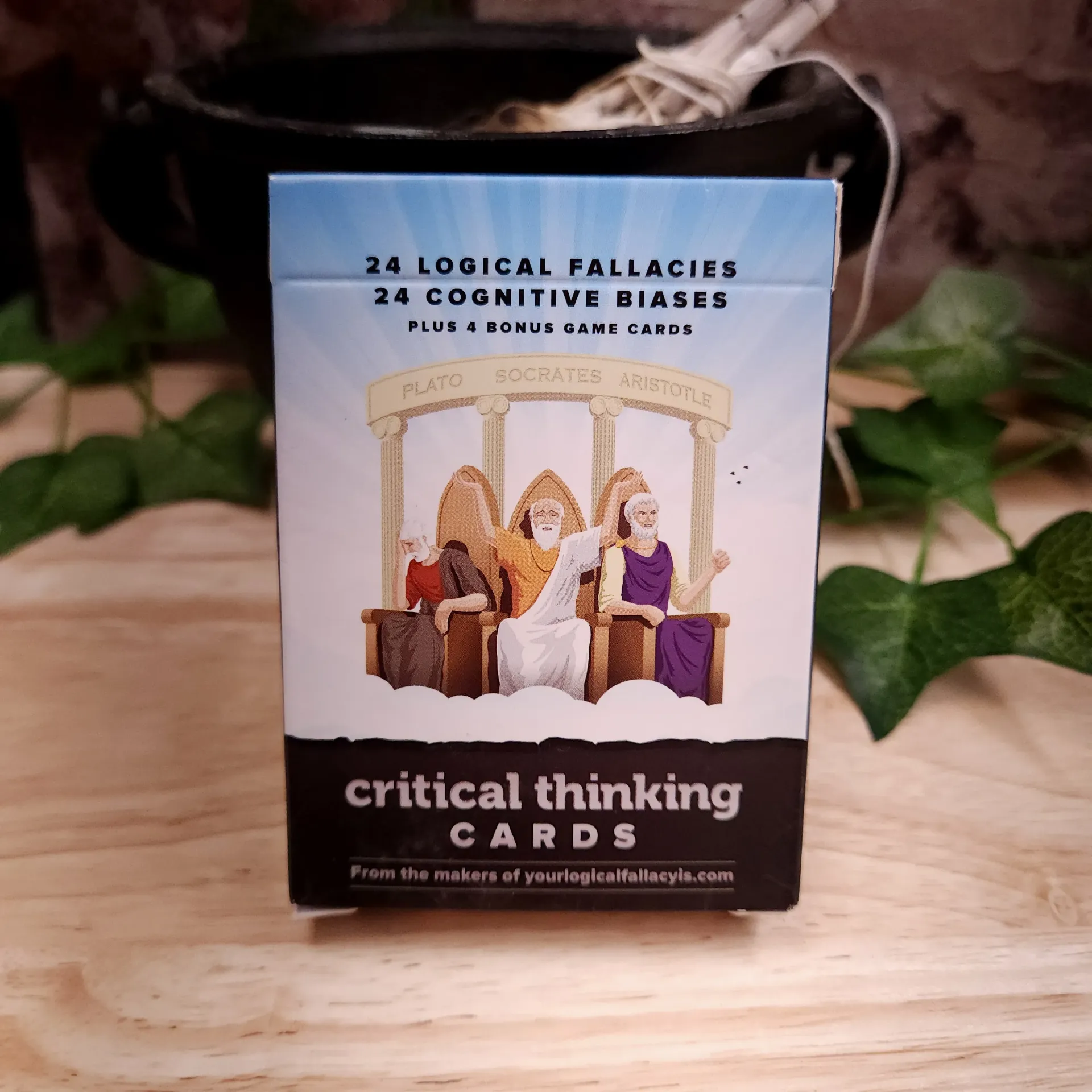
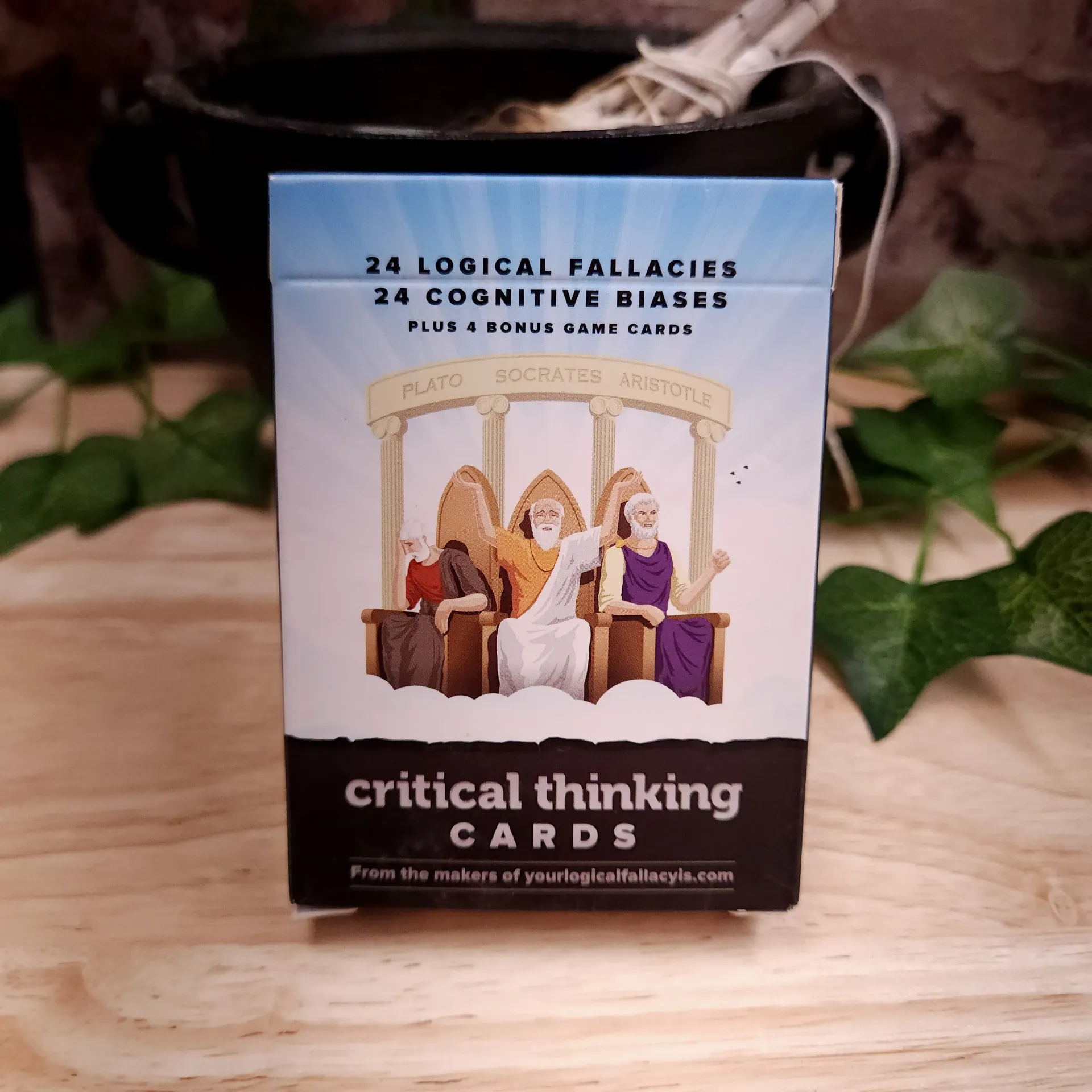
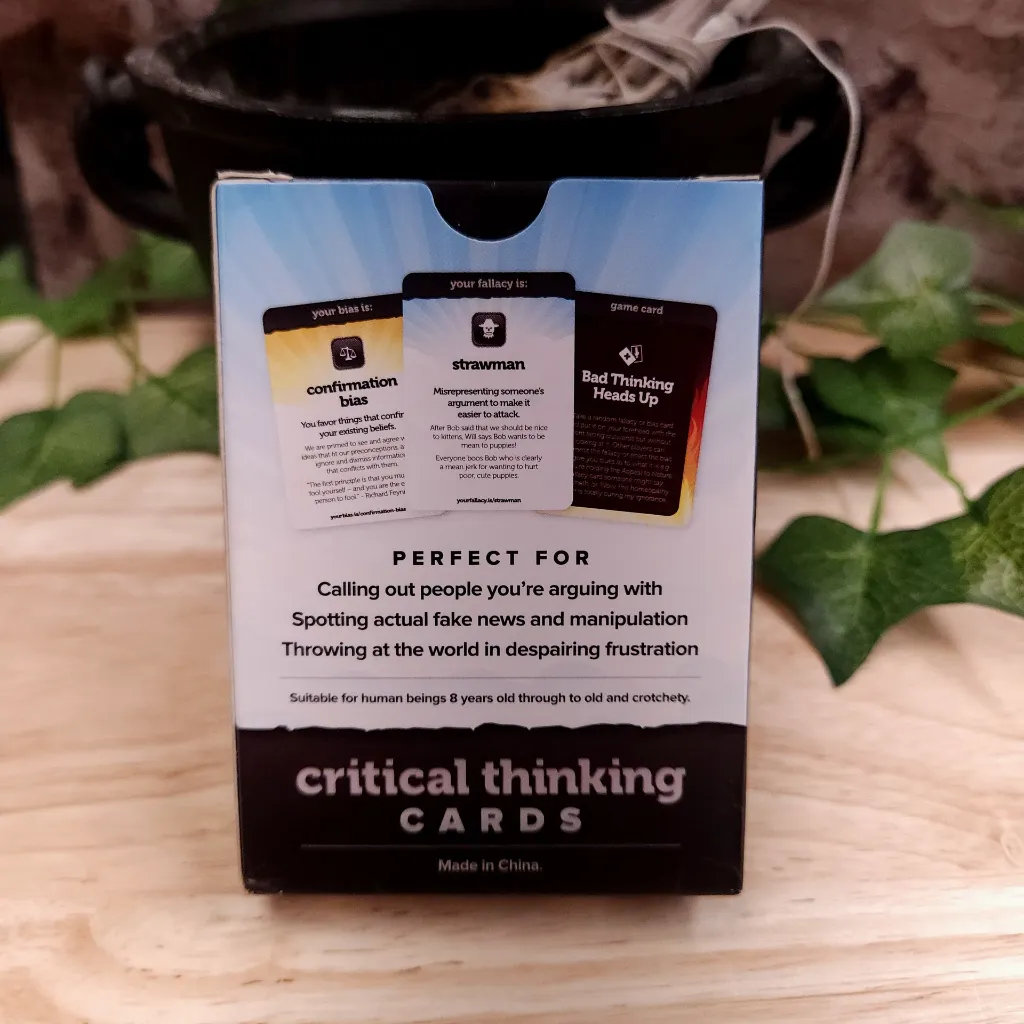
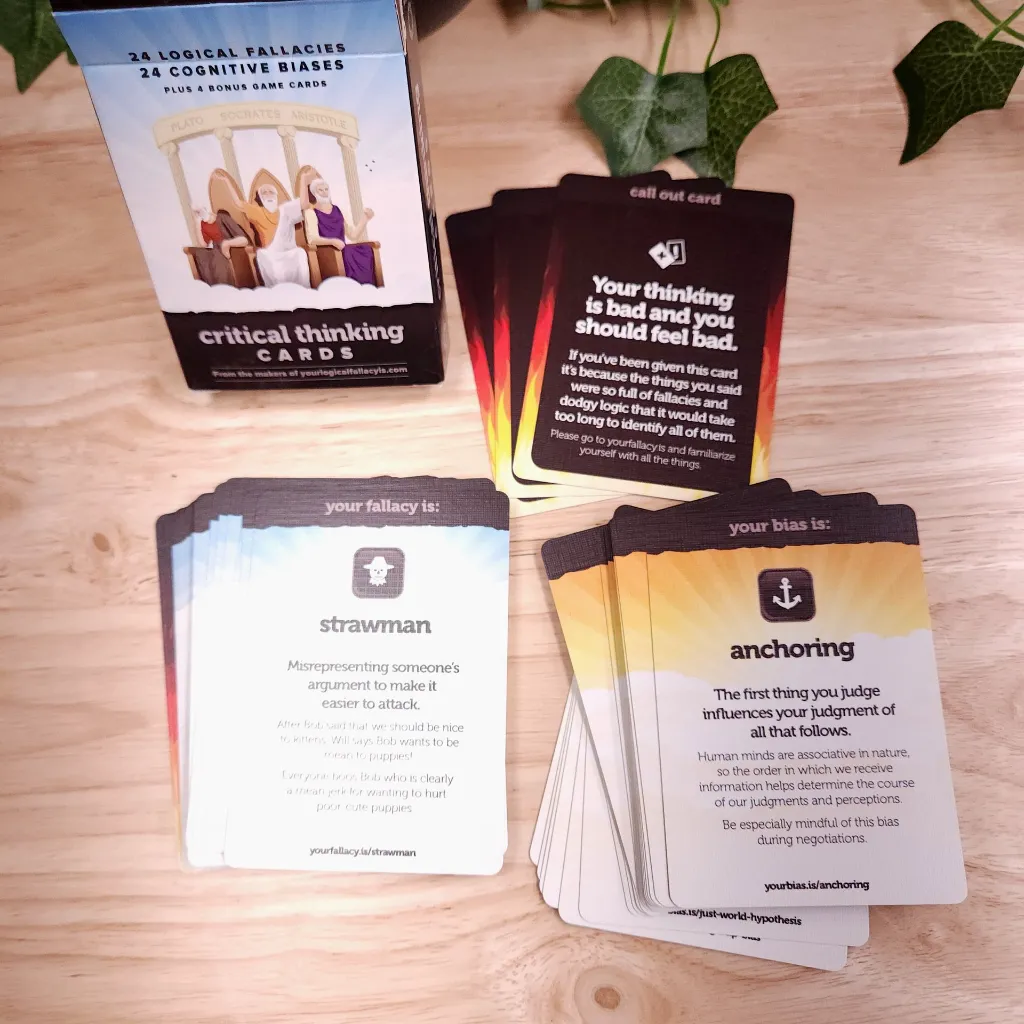
The deck has forty-eight thinking errors, one per card. Each card names the error, defines it in one line and gives a short, funny example. At the bottom is a web address for the full write-up. Half the deck covers logical fallacies, the ways an argument breaks. The other half covers cognitive biases, the shortcuts your own brain takes without asking you. You need both. The first kind shows you when someone’s trying to put one over on you. The second shows you when you’re doing it to yourself.
What you get
- 24 logical fallacy cards (“your fallacy is:”)
- 24 cognitive bias cards (“your bias is:”)
- Bonus game cards, including call-out cards for when someone’s argument has so many holes you can’t count them all
- Original tuck box
- Condition: pre-owned. Cards are in good condition. The box has shelf wear on its edges.
- Recommended for ages 8 and up
- Made in China
About the deck
Every card follows the same layout: the name, a one-line definition, a short scenario and a link. On the fallacy side you get classics like strawman (twisting someone’s argument so it’s easier to attack), slippery slope and false cause. On the bias side you get anchoring, confirmation bias and the just-world hypothesis. The game cards turn the deck into party games. Bad Thinking Heads Up is one: you hold a random card to your forehead while the other players act out the fallacy until you guess it. The deck also works as a reference set. Pull a card a day and you’ll start spotting that error everywhere within a week.
Provenance & tradition
The deck comes from School of Thought, a 501(c)(3) nonprofit in Austin, Texas. They run yourlogicalfallacyis.com and yourbias.is, and they release their materials under a Creative Commons license. The ideas are older than the website. Aristotle catalogued the first formal list of fallacies in Sophistical Refutations (On Sophistical Refutations), his handbook for spotting arguments that only look sound. The bias half comes out of 1970s behavioral psychology. Amos Tversky and Daniel Kahneman’s research on judgment under uncertainty is where anchoring got its name. So this deck holds about two thousand years of people working out how minds get fooled, written short enough to fit on cards.
Why it’s on a witch’s shelf
Discernment is a magickal skill. If you read tarot or runes, anchoring explains why the first card in a spread colors how you read every card after it. Confirmation bias explains why a querent hears the part of the reading they came in wanting. And if you work with return and consequence, it pays to know the just-world hypothesis well enough to notice when it’s doing your thinking for you. Sharp practice needs a sharp mind. This deck trains it.
Who this is for
Tarot and rune readers who want to keep their readings honest. Homeschool families looking for a hands-on logic supplement. Debate students. Coven study groups. Game nights. Anyone who argues online and is tired of losing to bad logic. It’s also a great gift for the skeptic in your life who’s convinced your shop is all woo.