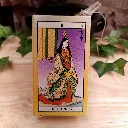
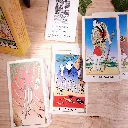
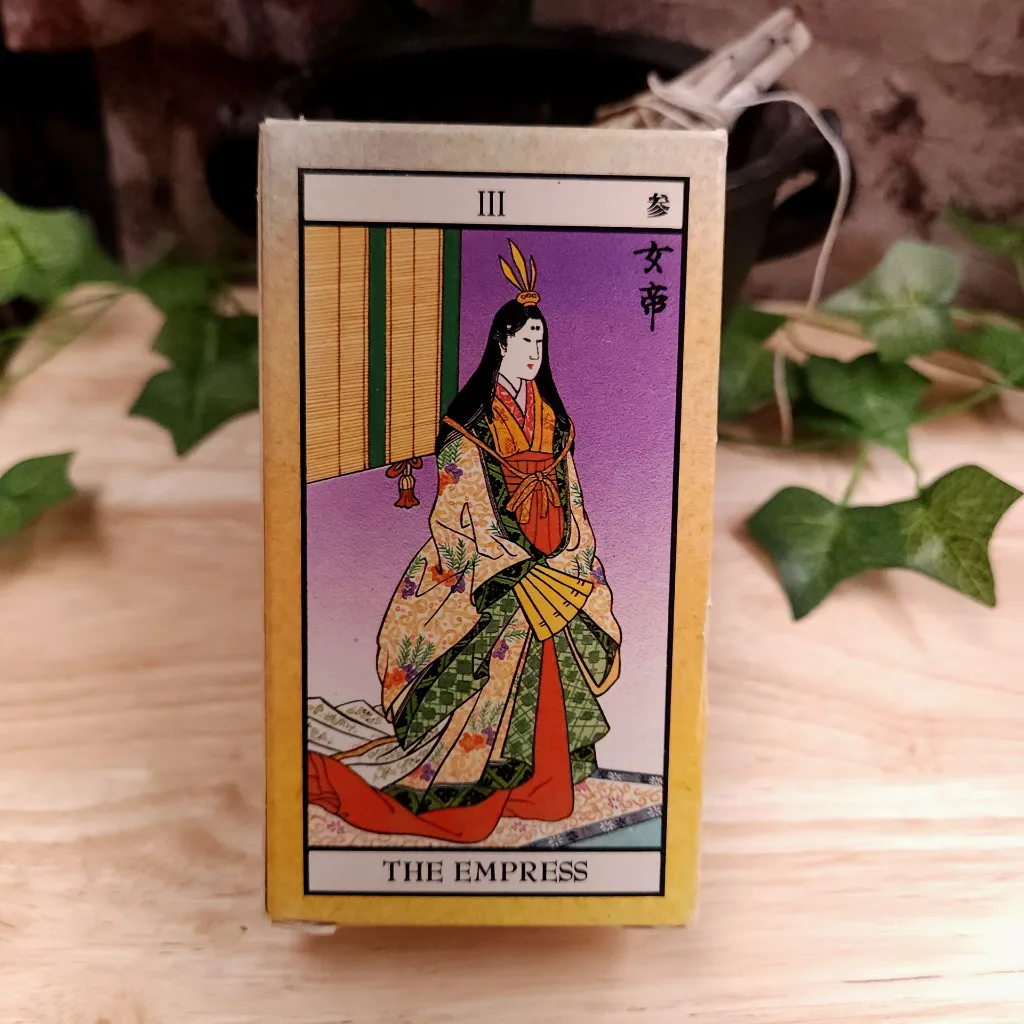
In 1980, Stuart R. Kaplan of U.S. Games Systems commissioned the Japanese artist Koji Furuta to paint a tarot in the ukiyo-e style. Furuta spent two years on the 78 paintings. The deck was printed in Japan and released in 1982, and this copy comes from that original run. The current reprint is easy to find. A vintage copy with cards this clean is a lot harder.
What you get
- 78-card tarot deck: 22 Major Arcana and 56 Minor Arcana
- Card titles in English and Japanese, with Japanese numerals on the trumps
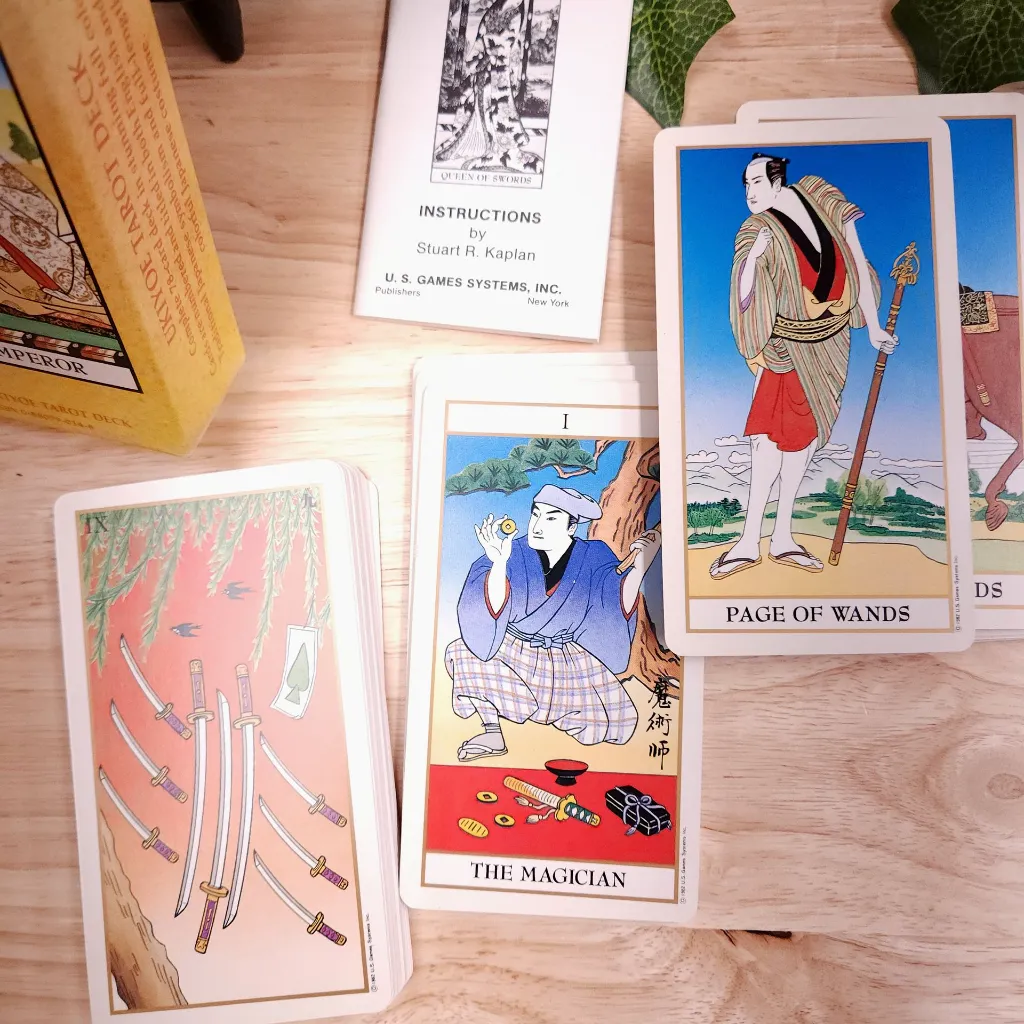
- Original instruction booklet by Stuart R. Kaplan, with the U.S. Games Systems New York imprint
- Original box, ISBN 0-88079-014-8, deck code UK78
- Condition: the cards look and feel unused, with no edge wear, bending or marks. The box has shelf wear on its edges and top flap, which you can see in the photos.
About the deck
Ukiyo-e means “pictures of the floating world.” It’s the art of Edo-period Japan (1603–1868), and the floating world was the pleasure quarters: kabuki actors, courtesans, wrestlers, travelers on the road. The word began as a Buddhist term for this sorrowful, passing world. Edo artists turned it into a joke about enjoying life while it lasts, and that double meaning suits tarot well.
Furuta’s cards are paintings done in the style of Edo woodblock prints, not prints themselves. The flat color fields and bold outlines come from that tradition. The suits are translated into Japanese objects: Wands become bishop’s staffs, Cups become sake cups, Swords become katana, and Pentacles become copper coins. You can see it on the Magician, whose table holds a coin, a sake cup and a short sword, with his title written beside him in kanji.
The pip cards show the suit symbols over painted backgrounds instead of full scenes, closer to the older European decks. The Nine of Swords is nine blades under willow branches with swallows passing through. Readers who learned on scenic pips will need to read from number, suit and atmosphere, and plenty of experienced readers prefer working that way. The Majors and court cards are full figure paintings, so you still have rich imagery where the deck’s big turning points are.
Who this is for
Collectors of vintage and out-of-print tarot, people who love Japanese art, and readers who want a quiet, elegant deck for their own practice. It’s a good deck for intermediate readers ready to move past scenic pips. It also makes a lovely gift for a tarot friend who seems to own everything already.