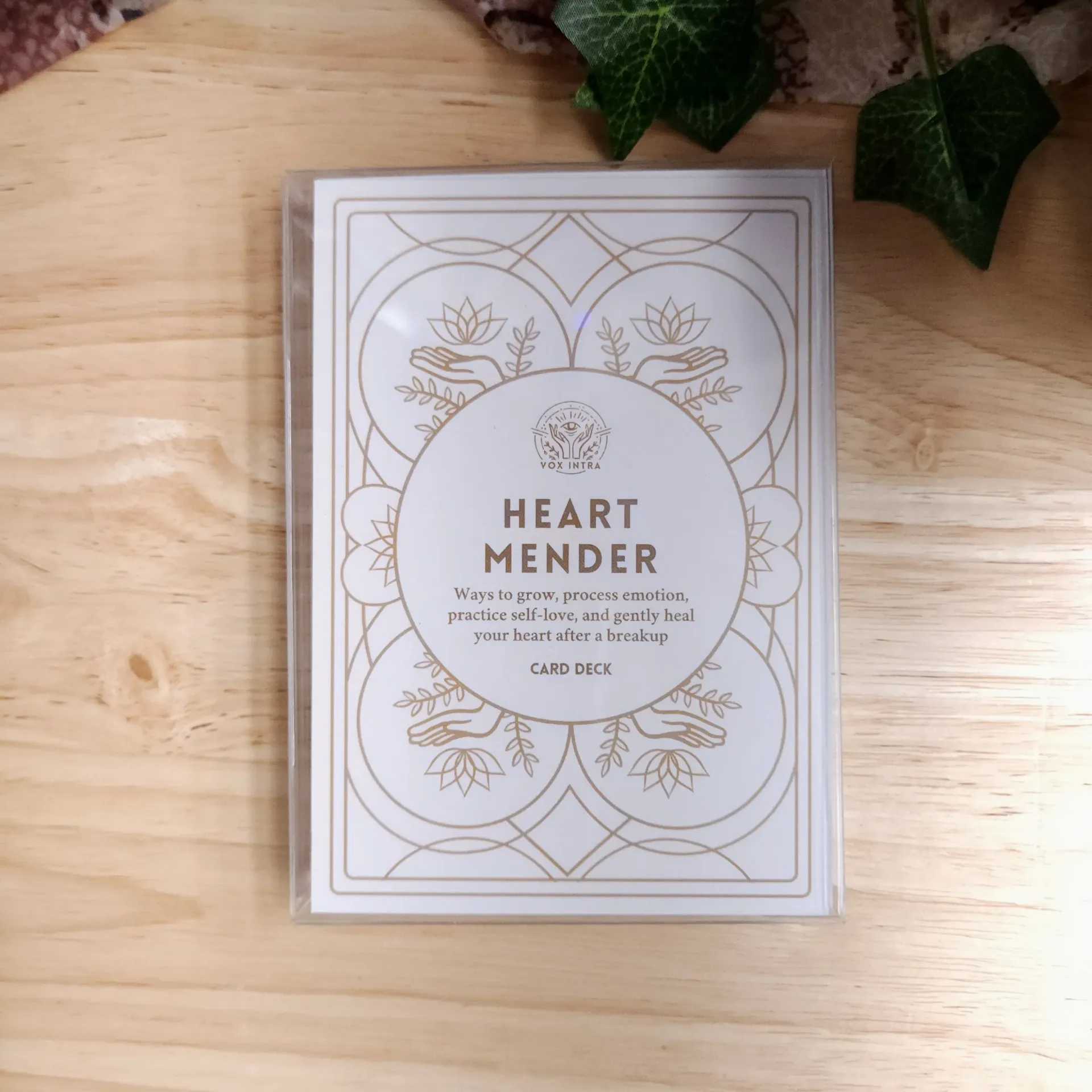
Heart Mender Breakup and Self-Love Deck
Twenty-nine cards holding more than forty exercises, sequenced to work as a program rather than a random draw. The maker describes it as what you follow in the first months after a breakup, and that framing is accurate: the deck has an arc, and working it in order gets you more than shuffling for a daily pull.
What you get
- 29 cards, 3.5 x 5 inches
- 40+ exercises across the deck
- "Heart Cards" that give you a defined entry point instead of requiring you to start at card one
- Written neutrally for any gender identity or orientation, with no assumed configuration of who left whom
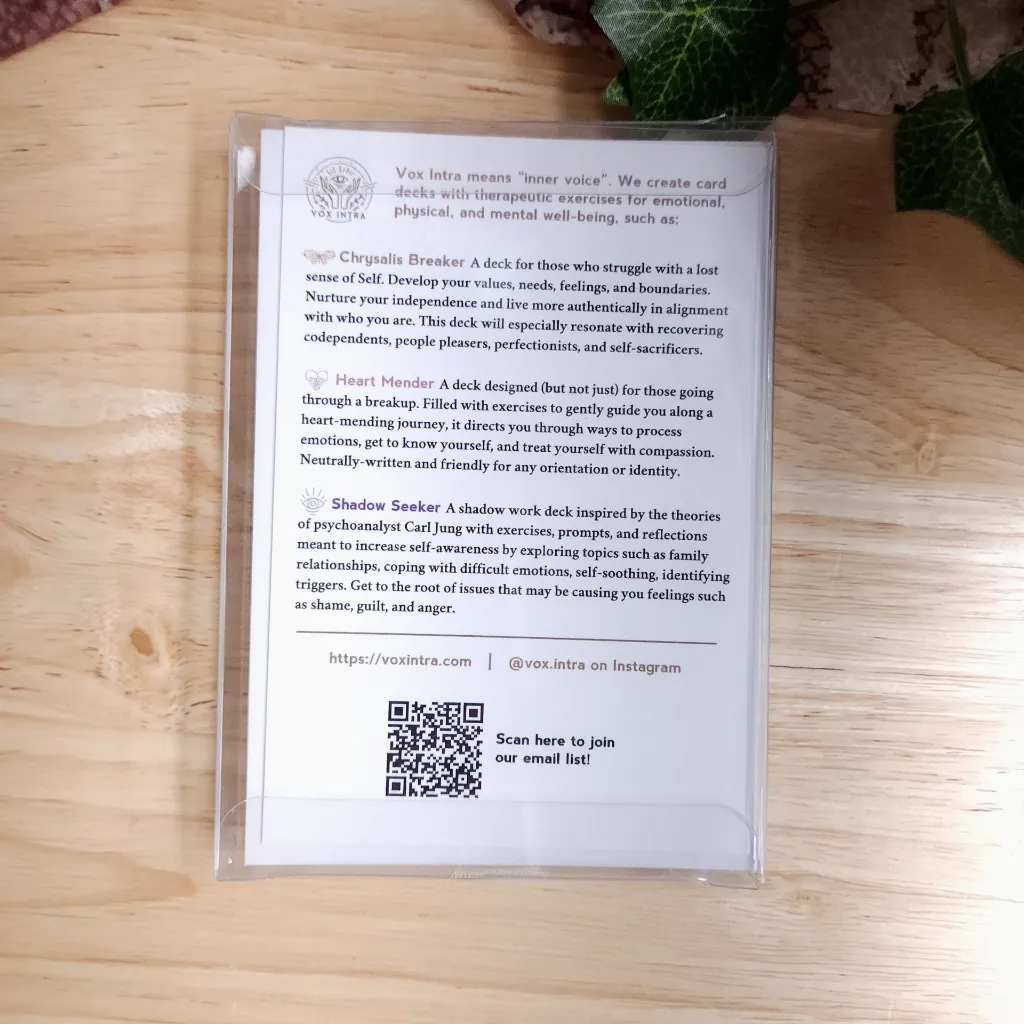
- Packaged in a clear protective case with printed front and back inserts
- Designed in Dallas, printed in the United States
- Ships at 0.27 lb
What's actually on the cards
The material draws on attachment theory, basic mindfulness practice, emotional regulation, validating feelings rather than arguing with them, and the specific skill of saying no. That last one earns its place. Most breakup content assumes the hard part is missing the person, when for a lot of people the hard part is holding a boundary they already decided on.
Provenance and tradition
The attachment framework here descends from John Bowlby's work in the 1950s and 60s, Mary Ainsworth's Strange Situation studies in 1970, and Hazan and Shaver's 1987 paper extending attachment styles to adult romantic relationships. That last piece is where the anxious/avoidant/secure vocabulary you see all over social media originated, and it's the layer this deck actually uses.
Kenneth Doka's term disenfranchised grief (1989) covers loss that a community doesn't formally recognize or ritualize. Breakups sit squarely inside it. Nobody brings a casserole. There's no service, no leave from work, no acknowledged mourning period. A structured deck of exercises is a modest substitute for a rite, but it does give the grief a shape and a schedule, which is most of what ritual provides.
The maker is explicit that this is not a tarot deck and functions closer to an oracle: no card meanings, no reversals, no spreads to learn. You draw or work through in sequence, and each card gives you an assignment. It pairs well with cord-cutting, cutting-away, or release work, where the ritual handles the moment and this handles the following six weeks.
These are self-reflection exercises, not therapy and not clinical treatment.
Who this is for
Anyone in the aftermath of a breakup, divorce, or the end of a long relationship. Grief that doesn't come from a death — estrangement, a friendship ending, a rejection that landed harder than it should have. People rebuilding after leaving a bad situation. Journalers. Practitioners who do release work and want structured aftercare. It's a good gift for a friend in the thick of it, precisely because it's practical rather than sympathetic.