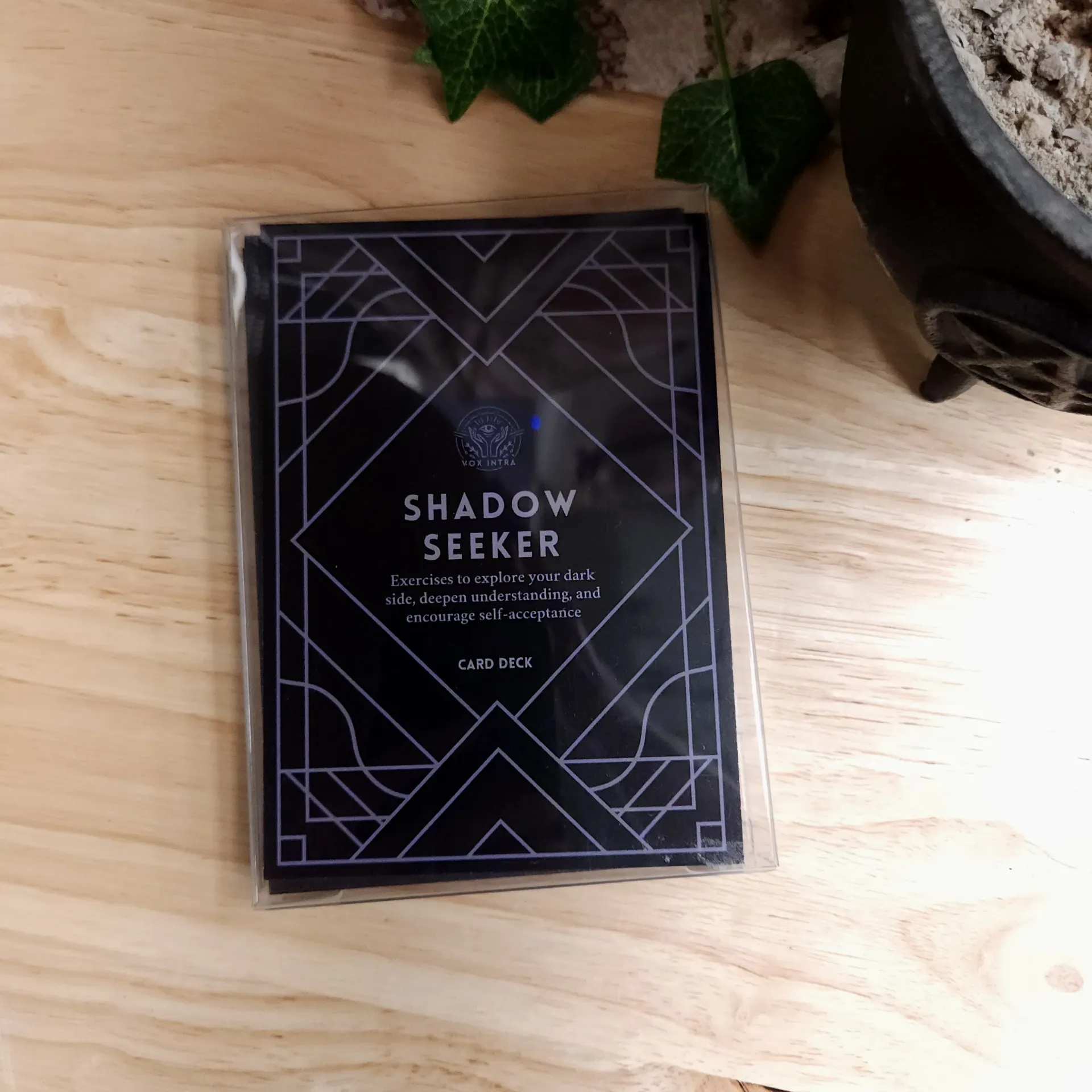
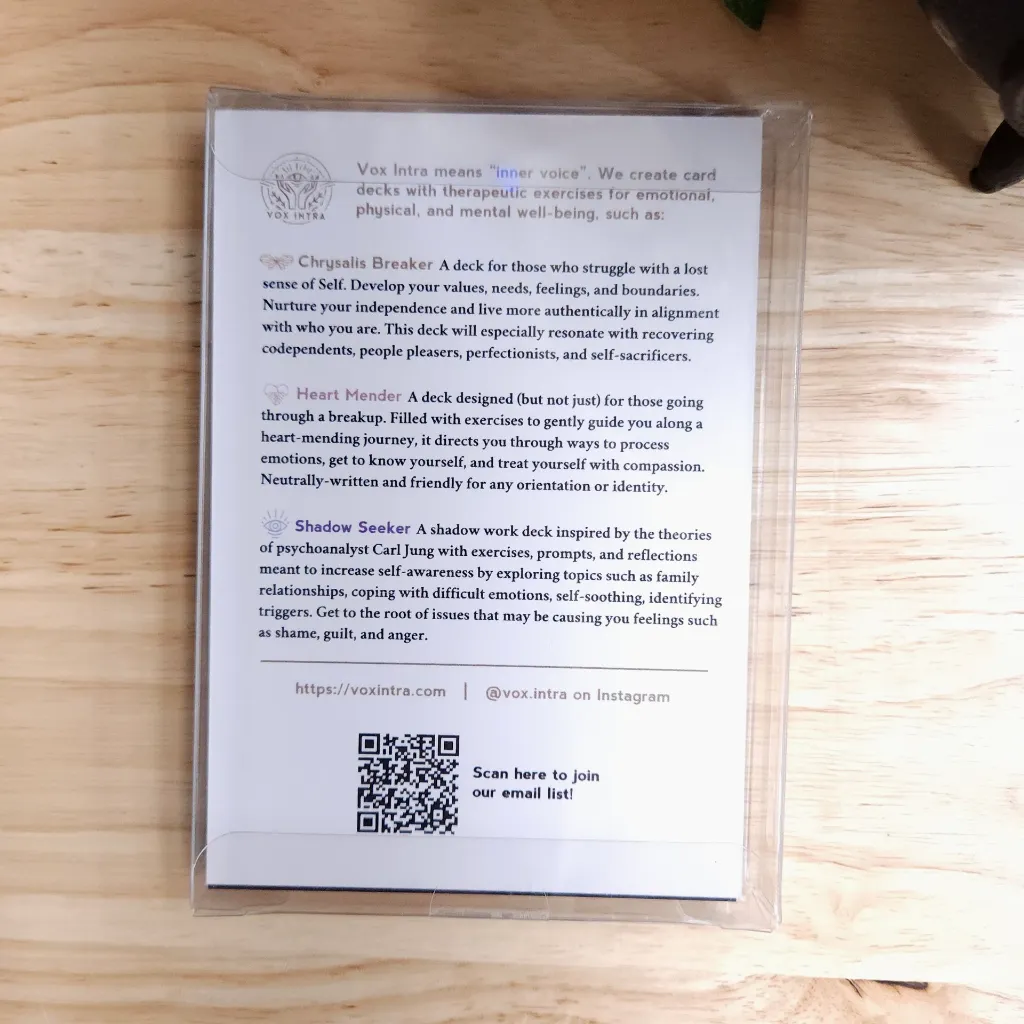
Shadow Seeker Shadow Work Deck
Thirty cards carrying more than seventy-five prompts, reflections, and activities, built to give the phrase "shadow work" an actual set of instructions. Most decks in this category hand you a mood. This one hands you an exercise and tells you what it's for.
What you get
- 30 cards, 3.5 x 5 inches
- 75+ prompts, reflections, and activities across the deck
- "Star Cards" that give you a defined starting point instead of requiring you to work front to back
- Each card introduces its topic and then supplies the exercise, so the deck runs without a separate guidebook
- Packaged in a matching paper hook box
- Designed in Dallas, printed in California
- Ships at 0.25 lb
Topics covered
Control. Self-worth. Bullying, both received and enacted. Triggers and the mechanisms you use to defend against them. Your working relationship with individual emotions. The root systems under shame, guilt, and anger. Envy and self-compassion each get their own treatment.
Provenance and tradition
"Shadow" is a technical term out of Carl Jung's analytical psychology: the parts of the personality that never made it into conscious awareness, including patterns actively working against you. Jung's own writing on it runs through the 1930s and 40s. The phrase reached a general readership decades later through depth-psychology-derived popular work; Robert Bly's A Little Book on the Human Shadow (1988) and the Zweig and Abrams anthology Meeting the Shadow (1991) are the usual doorways.
This deck stays on the psychological side of that lineage. The exercises draw on cognitive-behavioral approaches — reframing, trigger mapping, structured journaling — rather than correspondence or symbol systems. There are no card meanings, no reversals, no spreads, and nothing to memorize. You draw a card, you get an assignment. That makes it a very good companion to a tarot or oracle deck, particularly if you already pull cards and want structured follow-through afterward.
For practitioners: it sits well in dark-moon work, Samhain-season inner inventory, or any dedicant-level self-examination where you want the questions asked cleanly and without a symbolic layer to interpret first.
These are self-reflection exercises. They are not therapy, not clinical treatment, and not a replacement for working with a professional.
Who this is for
People who want to begin shadow work and can't find the door. Journalers who've run dry on prompts. Anyone in therapy who wants structure between sessions. Witches and pagans doing inner work who prefer their psychology unmixed with their magic. Solid as a gift — the packaging is handsome, and the subject matter reads as thoughtful rather than presumptuous.