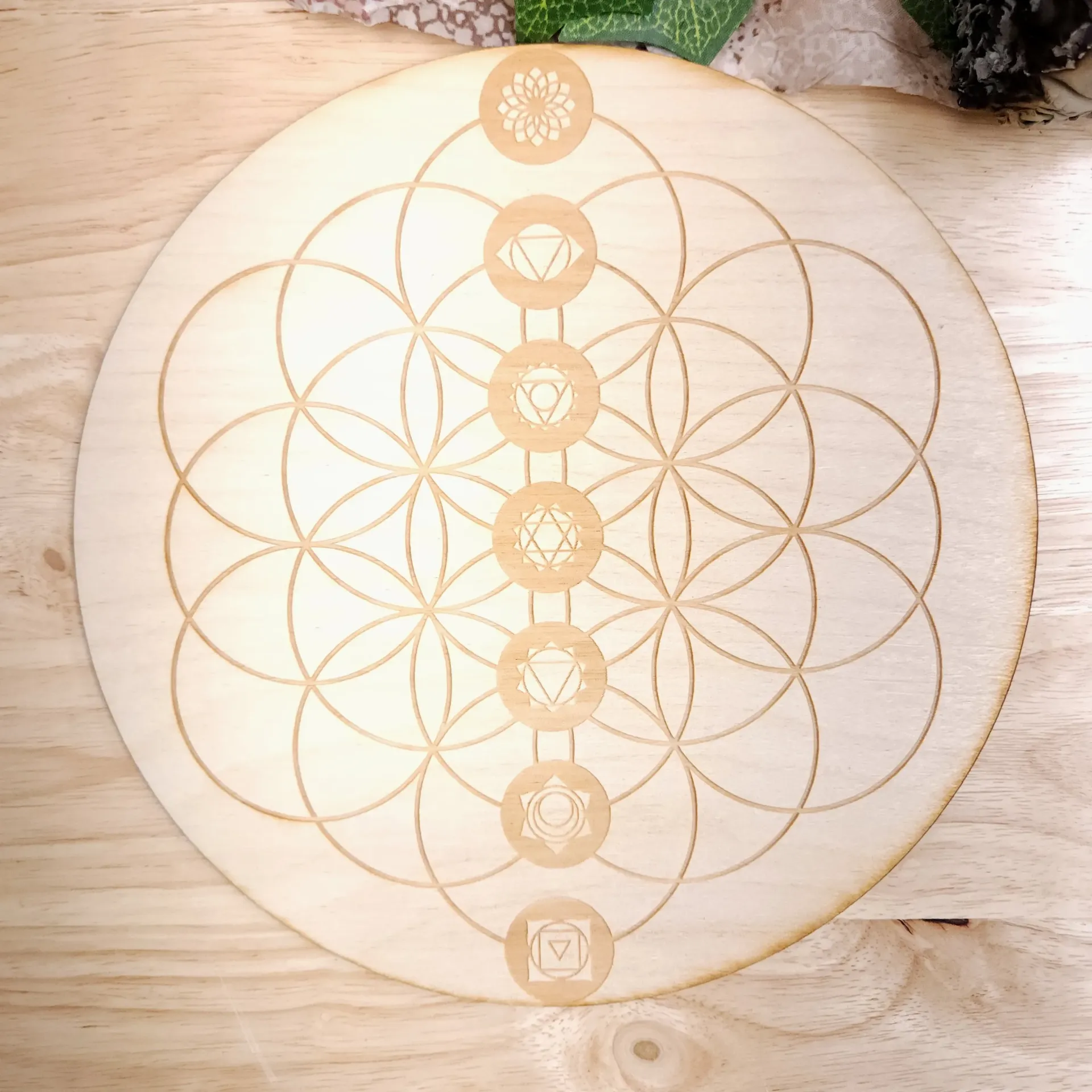
Eight inches across, 0.17 lb, cut as a plain disc with no border. The overlapping-circle lattice runs edge to edge at a fine, even line weight, and a column of seven engraved medallions runs vertically down the center from top to bottom, each holding a chakra yantra and each linked to the next by a pair of parallel channels.
The detail worth knowing about is which chakra iconography this board uses. These are the traditional Sanskrit yantra forms: the square enclosing a downward triangle at the base, the interlocking hexagram at the heart, the many-petaled lotus at the crown. Not the seven colored dots that most chakra merchandise settles for.
What you get
- One laser-etched wood crystal grid board, Flower of Life with seven chakra yantras
- 8 inches diameter
- 1/4 inch thick
- 0.17 lb
- Three-layer cross-grained plywood
- Unfinished
- Seven marked chakra stations in a vertical column
- Stones and crystals are not included
About the form
Plywood is three thin sheets laminated with each layer's grain running crosswise to its neighbors. At eight inches, that construction is why the disc stays flat rather than cupping across a few seasons of humidity swing, which a solid-wood round this thin would do.
The pattern is burned rather than cut through. A laser at engraving power vaporizes a shallow channel along each line and scorches the walls, producing the warm edge on every stroke. Light exposure fades it toward pale over months.
Unfinished wood absorbs. Oils, wax, and water soak in and stay, and the board takes a patina where your hands rest. Wipe-on matte polyurethane or paste wax will seal it if you want it pale; leave it bare if you want it to record its use. Bare wood also takes a wood-burner cleanly if you want to add your own marks.
Provenance and tradition
The lattice is built from circles of equal radius, each centered on the circumference of its neighbors, repeating outward in hexagonal packing. Each intersection produces a vesica piscis, which is why it looks like petals. The overlapping-circle motif has a long documented life in ornament across Roman mosaic, Islamic geometric design, and medieval European carving. The name "Flower of Life" attached to it is a twentieth-century coinage from English-language sacred geometry writing.
The chakra system comes from tantric Hindu and Buddhist textual tradition, where the seven-centre model most familiar in the West traces principally to the Ṣaṭ-cakra-nirūpaṇa and the material that entered English through Arthur Avalon's translations in the early twentieth century. The yantras engraved here follow that iconography: petal counts, enclosed geometric forms, and the vertical column corresponding to the suṣumṇā, the central channel.
Who this is for
Chakra stone layouts, crystal grid work, Reiki and energy practice, meditation focus, teaching aids, altar centerpieces, and wall display. The seven marked stations give you a ready-made column: place a stone at each and the board holds the layout without you measuring anything. For the root station, traditional stone choices include hematite, smoky quartz, garnet, bloodstone, red tiger's eye, and obsidian. At eight inches the board takes full-size tumbled stones and palm stones rather than only chips.