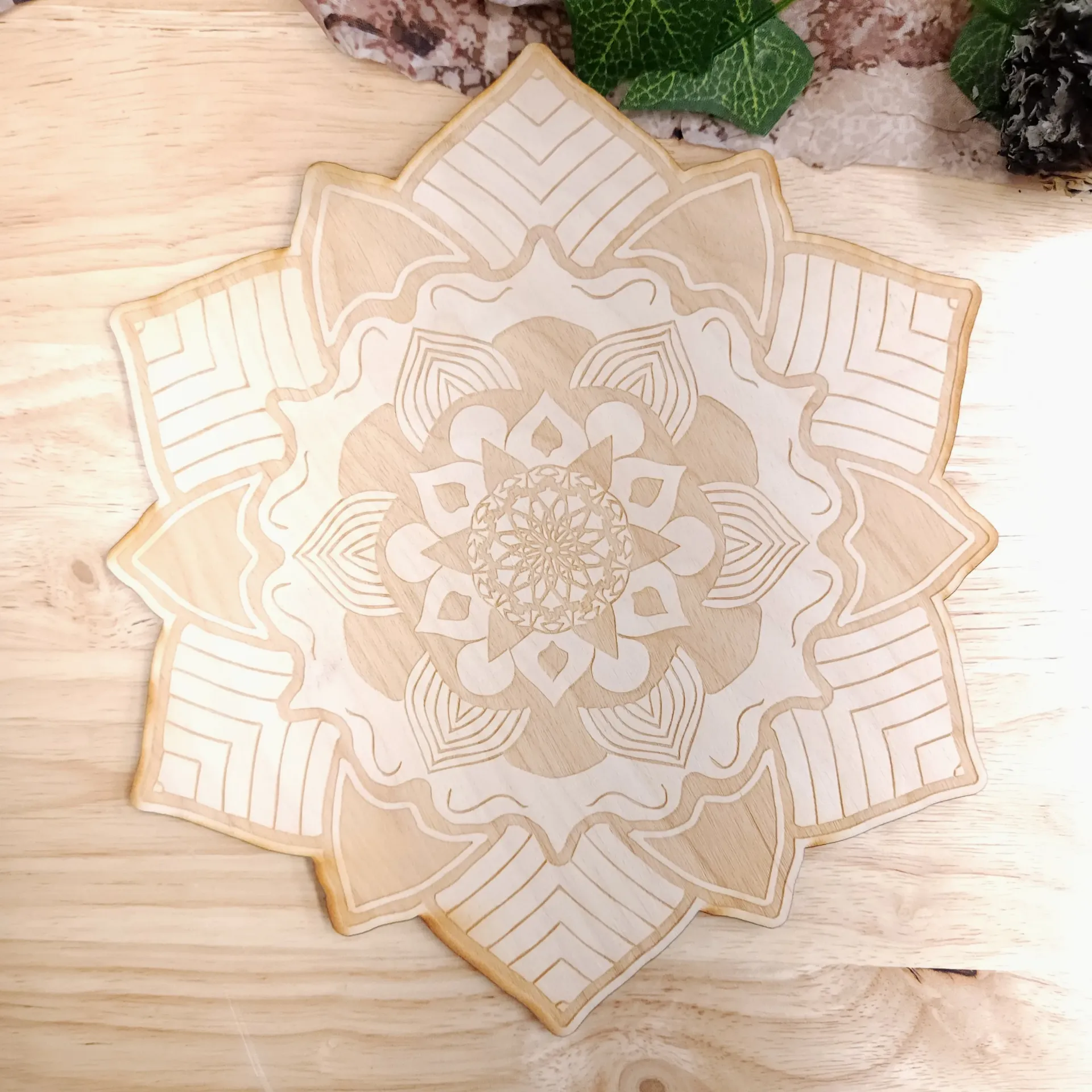
Eight inches point to point, 0.15 lb, cut to a many-pointed petal outline. The engraving works at two scales on this board. Broad fields are cleared to a lower level so the petal registers stand distinct from one another, giving the surface real contour under a thumb, while the center rosette is cut at a line weight fine enough that the detail crowds together into something closer to lace than to line work. Those two treatments in one piece are what makes it hold attention at arm's length and at reading distance both.
What you get
- One laser-engraved wood crystal grid board, geometric lotus mandala
- 8 inches point to point
- 1/4 inch thick
- 0.15 lb
- Three-layer cross-grained plywood
- Unfinished
- Stones and crystals are not included
About the form
Plywood is three thin sheets laminated with each layer's grain running crosswise to its neighbors. On a board this size cut into a ring of points, that construction keeps the tips from shearing off along a grain line. At eight inches the board lifts fully loaded with one hand.
The cleared fields have a practical consequence for grid work. Small stones settle into the lowered areas rather than sliding, which many people prefer when a working needs to hold position for days. Large flat-bottomed pieces bridge across the raised registers and sit slightly proud.
Removing that much material produces more scorch, which is the source of the warm tone across the lowered fields. It fades toward pale over months of light exposure.
Unfinished wood absorbs, and cleared fields absorb faster than flat surfaces because more end grain sits exposed. Oils, wax, and water soak in and stay. Wipe-on matte polyurethane or paste wax will seal it. Left bare it darkens with handling, which on a piece with this much texture becomes attractive rather than shabby.
Provenance and tradition
Mandala is Sanskrit for circle. In Hindu and Buddhist ritual the word names a specific class of consecrated diagram with fixed proportions, assigned positions, and liturgy attached: the tantric yantra, the Tibetan sand mandalas built and swept away, the Kalachakra. This board belongs to a different category, the broader decorative sense the English word took on during the twentieth century after Jung's writing on circular imagery pushed it into general use.
The ornamental vocabulary here is mixed. The layered petal registers and the lotus outline come from South Asian decorative tradition. The angular stepped banding filling the outer points is fretwork, a motif that developed independently in Greek meander ornament, in Chinese leiwen cloud-and-thunder patterns, and in Mesoamerican step-fret design. Combining them is a contemporary design choice rather than the practice of any single tradition.
For working purposes the geometry gives you a defined center, concentric registers moving outward, and even radial division to build a layout against.
Who this is for
Crystal grid layouts at full scale, altar centerpieces, a base for a candle or a large single specimen, meditation focus, and wall display. At eight inches this takes full-size tumbled stones and palm stones rather than only chips, and it holds a table on its own. Also serviceable as a trivet-style base under a bowl or small cauldron, as long as nothing hot or wet touches bare wood.