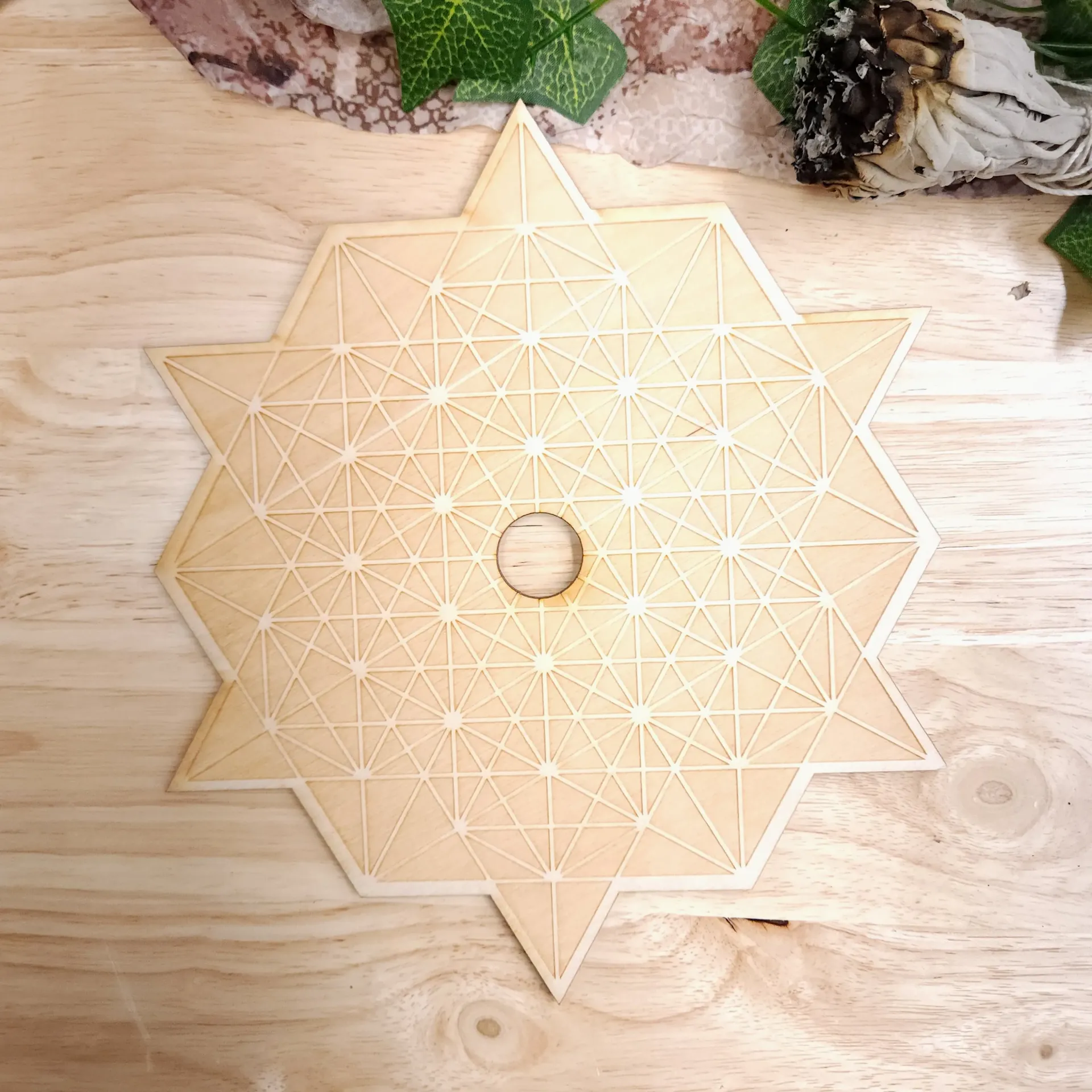
Eight inches point to point, 0.12 lb, cut to an eight-pointed star outline formed by two overlapping squares. The face carries a uniform triangular lattice at fine line weight, running edge to edge without a border. A circular opening is bored clean through the board near the center.
That opening is the piece's distinguishing feature and its open question. Practically, it will seat a small sphere so the sphere cannot roll, accept a point dropped partway through to stand upright, or take a cord if you want the board on a wall.
What you get
- One laser-etched wood crystal grid board, 64 tetrahedron lattice in an eight-point star
- 8 inches point to point
- 1/4 inch thick
- 0.12 lb
- Three-layer cross-grained plywood
- Unfinished
- One bored circular opening through the board, 3/4"
- Stones and crystals are not included
About the form
Plywood is three thin sheets laminated with each layer's grain running crosswise to its neighbors. On a board with eight long tapering points, that construction is the whole reason the tips survive handling; solid wood would shear off along the grain at the first knock.
The pattern is burned rather than cut through. A laser at engraving power vaporizes a shallow channel along each line and scorches the walls, giving the warm edge on every stroke. Light exposure fades it toward pale over months. Grain varies sheet to sheet, so your board will not match the photograph.
The bored opening has exposed edge grain around its rim, and edge grain is the thirstiest surface on any wooden object. It will darken first and absorb fastest.
Unfinished wood absorbs generally. Oils, wax, and water soak in and stay. Wipe-on matte polyurethane or paste wax will seal the board if you want it pale; leave it bare if you want it to darken with use. Bare wood also takes a wood-burner cleanly if you intend to add marks of your own.
Provenance and tradition
The lattice is an isometric triangular grid, the two-dimensional projection of a stacked tetrahedral array. The construction it depicts is elegant geometry: eight star tetrahedra, each itself built from eight tetrahedra, cluster around a common center to make sixty-four, and the cluster's outer envelope corresponds to the cuboctahedron that Buckminster Fuller named the vector equilibrium, the only polyhedron whose edge length equals its radius.
The name "64 Tetrahedron Grid" and the physics claims that circulate alongside it entered wide use through Nassim Haramein's work in the 2000s. The geometry stands on its own merits. The unified-field physics attached to it has not been accepted by the physics community.
The outline is an octagram formed by two superimposed squares rotated forty-five degrees. That figure appears independently across many ornamental traditions, prominently in Islamic geometric design and in South Asian decorative work, where it carries different names and meanings in each.
Who this is for
Crystal grid layouts, especially large ones. The lattice gives well over a hundred evenly spaced intersection points, which suits grids built from many small stones and gives you real freedom in how you space a working. Also good as an altar centerpiece, a display base with a sphere seated in the opening, a meditation focus, and a wall piece. At eight inches this holds a table on its own and takes full-size tumbled stones comfortably rather than only chips.