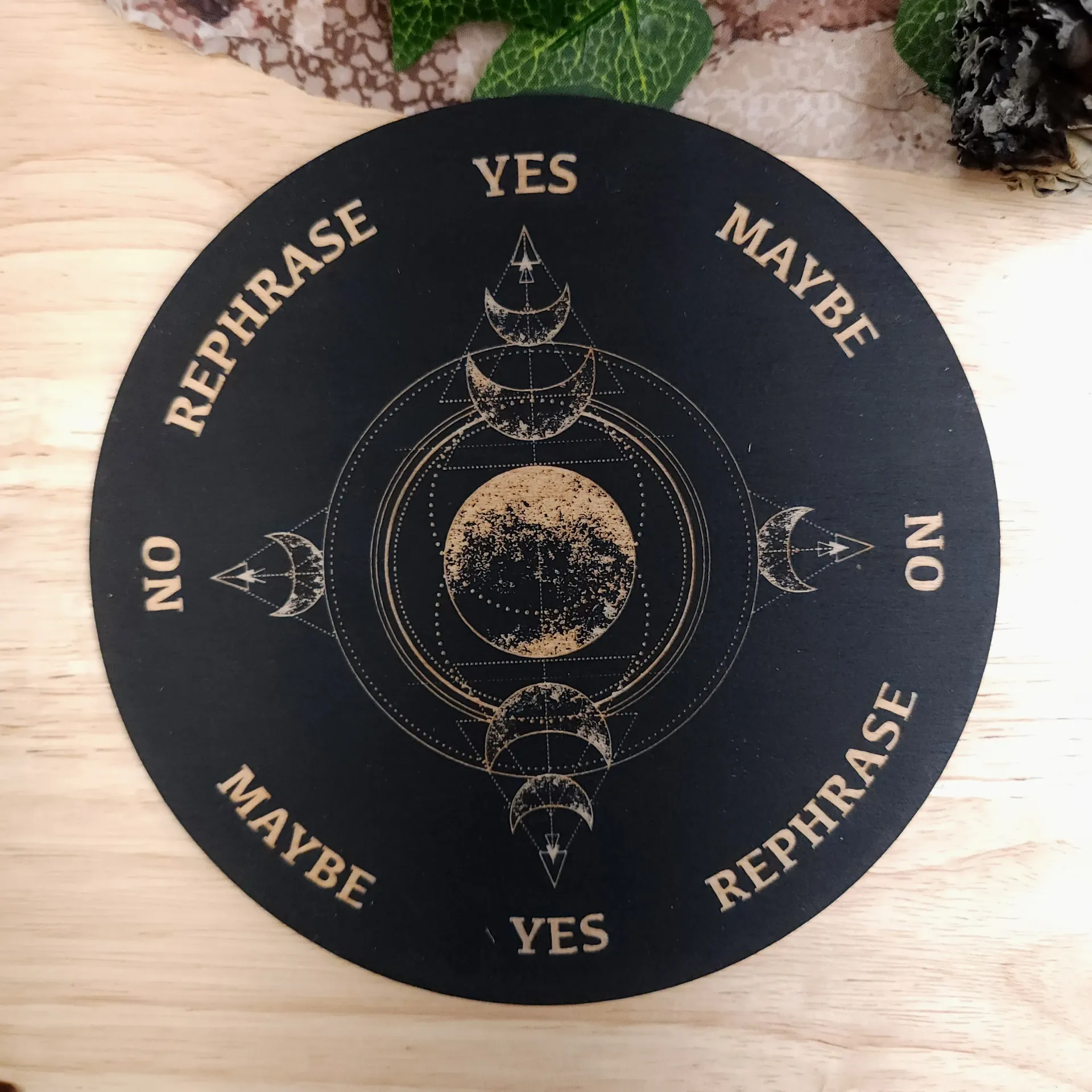
Six inches across, 0.1 lb, quarter-inch plywood with a black finish on the face. The engraving works in reverse here: the laser cuts through the dark surface to expose pale wood beneath, so every letter and every moon sits bright against black instead of being scored into a bare face. High contrast, easy to read across a table in low light.
Eight answer stations ring the board, and they are doubled rather than distinct: yes, maybe, no, and rephrase, each appearing twice at opposite positions, with the text on each half oriented to be read from that side. Two people sitting across from one another can both read the board upright, which is helpful when reading for others.
What you get
- One laser-engraved wooden pendulum board, moon phase design
- 6 inches diameter
- 1/4 inch thick
- 0.1 lb
- Three-layer cross-grained plywood
- Black laser-burned face with engraving cut through to bare wood
- Pendulum is not included
- Eight answer stations: yes, maybe, no, rephrase, each appearing twice
About the form
Plywood is three thin sheets laminated with each layer's grain running crosswise to its neighbors, which keeps a disc this thin flat rather than cupping across seasons.
Unfinished wood bare and porous. Oils and moisture will wick into the surface, and dark liquid will stain the pale letters permanently. Wipe with a dry cloth. Keep candle drip and anointing oil off it.
The center carries a full lunar disc with mare detail, concentric geometry rings, and phase progressions running out along four axes. Grain shows faintly through the finish in places.
Provenance and tradition
Pendulum work belongs to the broader family of dowsing. The documented European record for dowsing as a technical practice begins with mining: Georgius Agricola describes and criticizes the forked divining rod used to locate ore in De Re Metallica, published in 1556. Earlier binary divination in Europe used other rigs entirely, the sieve-and-shears method among them, where a suspended sieve was watched for movement in answer to a question.
The suspended weight over a lettered or worded board is much more recent. The French term radiesthésie, coined in the 1930s, covers the pendulum-based branch of the practice, and boards printed or engraved with fixed answer positions belong to that modern period rather than to any medieval or ancient one.
The "rephrase" station is a modern design convention and a genuinely good one. It gives a pendulum somewhere to land when a question is compound, leading, or badly framed, which prevents the common beginner error of forcing a yes or no out of a question that contains two questions. A board without that station teaches worse habits than a board with it.
Who this is for
Pendulum work and dowsing, decision practice, beginner divination, altar decoration, and gifts for anyone building a first toolkit. The doubled layout suits anyone who reads across a table from another person. Pair it with any pendulum; the board holds no preference about chain length or stone.