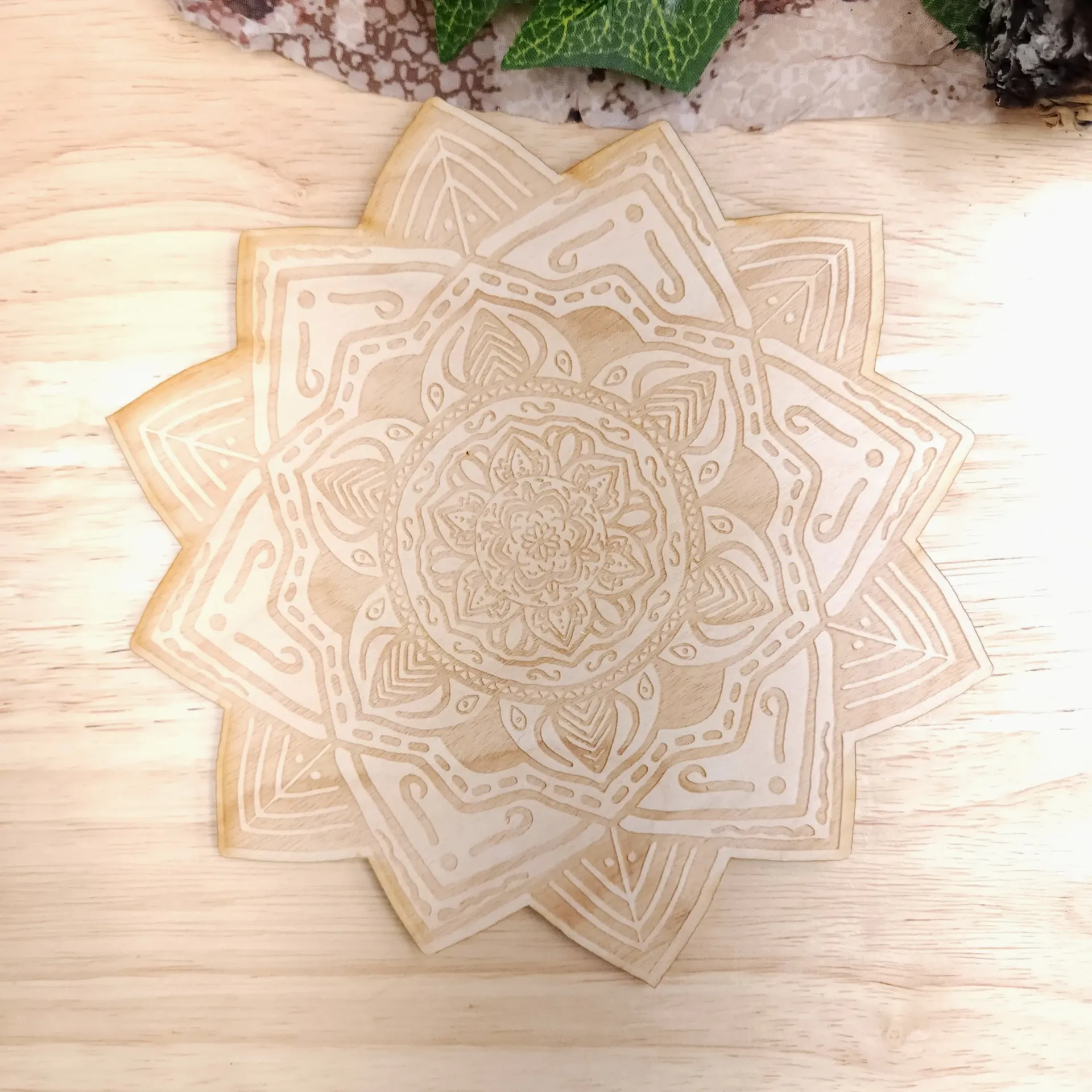
Quarter-inch plywood cut to a pointed petal outline, six inches point to point and 0.09 lb. The engraving on this one is extra: the laser cleared the entire background field and left the line work standing proud, so the pattern sits raised above a lowered surface rather than being scored into a flat face. That takes many times the machine time of a line engrave, and it gives the board real tactile depth. You can feel the whole design with your fingertips.
What you get
- One laser-engraved wood crystal grid board, lotus mandala in raised relief
- 6 inches point to point
- 1/4 inch thick
- 0.09 lb
- Three-layer cross-grained plywood
- Unfinished
- Stones and crystals are not included
About the form
Plywood is three thin sheets laminated with each layer's grain running crosswise to its neighbors. On a board cut into a dozen narrow points, that cross-lamination is the reason the tips don't snap off along a grain line. At a quarter inch and six inches across, the board is rigid enough to lift fully loaded with one hand.
The relief engraving has a practical consequence. Because the background field sits lower than the line work, small stones will find the recesses and settle rather than sliding, which many people prefer for grid work. Large flat-bottomed pieces will bridge across the raised lines and sit slightly proud.
Removing that much material also means more scorching, which is where the deep amber tone across the lowered field comes from. It will lighten over months of light exposure.
Unfinished wood absorbs. Oils, wax, and water will soak in and stay, and the relief field will take them faster than a flat surface would because more end grain is exposed. Wipe-on matte polyurethane or paste wax will seal it if you want it pale. Leave it bare if you want it to darken with use.
Provenance and tradition
Mandala is Sanskrit for circle or disc. In Hindu and Buddhist ritual practice the word names a specific class of consecrated diagram, with fixed proportions, assigned positions, and liturgy attached: the tantric yantra, the Tibetan sand mandalas built and then swept away, the Kalachakra. This board belongs to a different category. It is decorative radial ornament in the sense the English word acquired during the twentieth century, when Jung's writing on circular imagery pushed "mandala" into general use for any concentric symmetrical design.
Teardrop paisley forms, dotted borders, curling hook motifs, and layered petal registers belong to South Asian decorative tradition, mehndi line work and block-printed textile design in particular. Beautiful, specific, and secular in origin.
For working purposes, the geometry gives you a clear center, concentric registers moving outward, and even radial division. Lotus iconography carries an emergence theme across a great many traditions, the flower rooted in mud and opening at the surface, which suits work on unfolding, patience, and beginnings.
Who this is for
Crystal grid layouts, meditation focus, altar decoration, a base for a candle or a single large stone, and gifts. At six inches this is a display piece as much as a working tool: it holds a table on its own, and it takes a full grid of tumbled stones with room to spare. Also good as a trivet-style base under a bowl or a small cauldron, provided nothing hot or wet touches the bare wood.