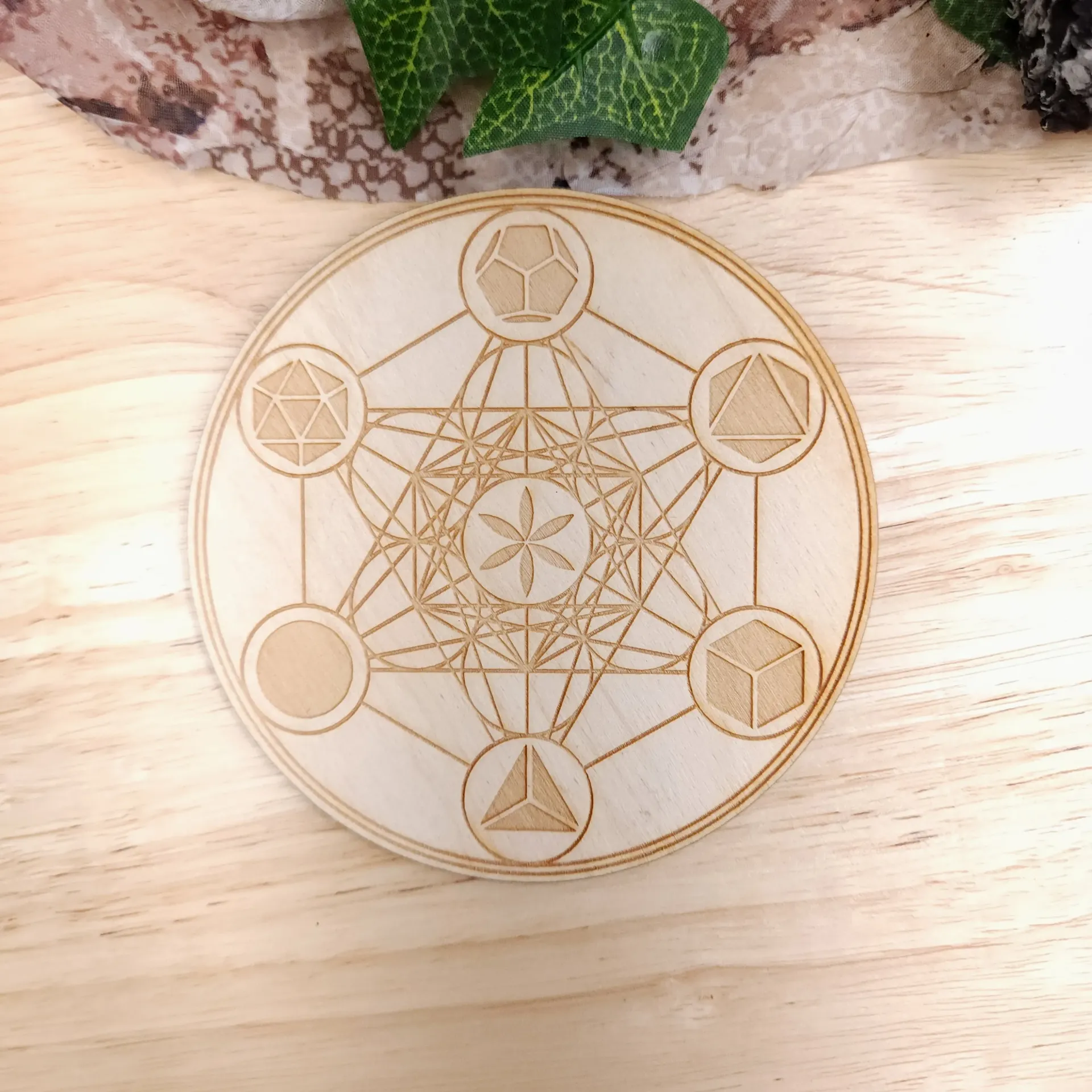
Quarter-inch plywood cut as a plain disc, with a double-scored border framing the whole design. The center field carries the full Metatron's Cube lattice at fine line weight. Six circular stations sit around it: five hold individual Platonic solids drawn in perspective, one is left blank, and a six-petal rosette occupies the center. Four inches across, 0.05 lb.
What you get
- One laser-etched wood crystal grid board, Platonic solids around a Metatron's Cube lattice
- 4 inches diameter
- 1/4 inch thick
- 0.05 lb
- Three-layer cross-grained plywood
- Unfinished
- Stones and crystals are not included
About the form
Plywood is three thin sheets laminated with each layer's grain running crosswise to its neighbors. A disc this thin stays flat because of it, where a solid-wood round of the same dimensions would cup after a few seasons of humidity swing.
The design is burned rather than cut through. A laser at engraving power vaporizes a shallow channel along each line and scorches the walls, producing the amber edge you see on every stroke. Light exposure fades that scorch toward pale over months. Grain differs sheet to sheet, so your board will not match the photograph.
Unfinished wood absorbs. Oils, wax, and water soak in permanently, and the board takes a patina where your hands rest most. Wipe-on matte polyurethane or paste wax will seal it. Bare wood also accepts a wood-burner cleanly if you want to add marks of your own.
Provenance and tradition
The five solids are the only convex polyhedra with identical regular faces meeting identically at every vertex, and there are exactly five, which Euclid proves in Book XIII of the Elements. Theaetetus is generally credited with the mathematical work behind that proof. Plato assigns them elemental correspondences in the Timaeus: tetrahedron to fire, cube to earth, octahedron to air, icosahedron to water, and the dodecahedron to the whole cosmos, which later tradition renders as aether or spirit.
That mapping is the practical gift of this particular board. Set a fire stone at the tetrahedron, an earth stone at the cube, and so on, and the layout does elemental work without any additional system layered on top.
The underlying lattice is drawn from thirteen circles in hexagonal packing with every center joined to every other center. It circulates under the name Metatron's Cube, and that pairing of an angel from Jewish mystical literature with this diagram is a twentieth-century development in English-language sacred geometry writing, not an old one.
The common claim is that all five solids can be traced out of the lattice itself. Practically speaking, three of them can be easily. The dodecahedron and icosahedron require a generous reading of which lines count. This board sidesteps that argument by drawing the solids as separate figures around the ring rather than asserting they live inside the lines.
Who this is for
Elemental grid work, crystal grid layouts, teaching aids for classes on sacred geometry or the classical elements, altar decoration, a charging surface for a single stone, meditation focus, and travel altars. The six outer stations plus a center make seven placements, and one of those stations carries no solid, which leaves it open for a master stone, a significator, or whatever your system needs there. Best with tumbled stones, chips, and small points.