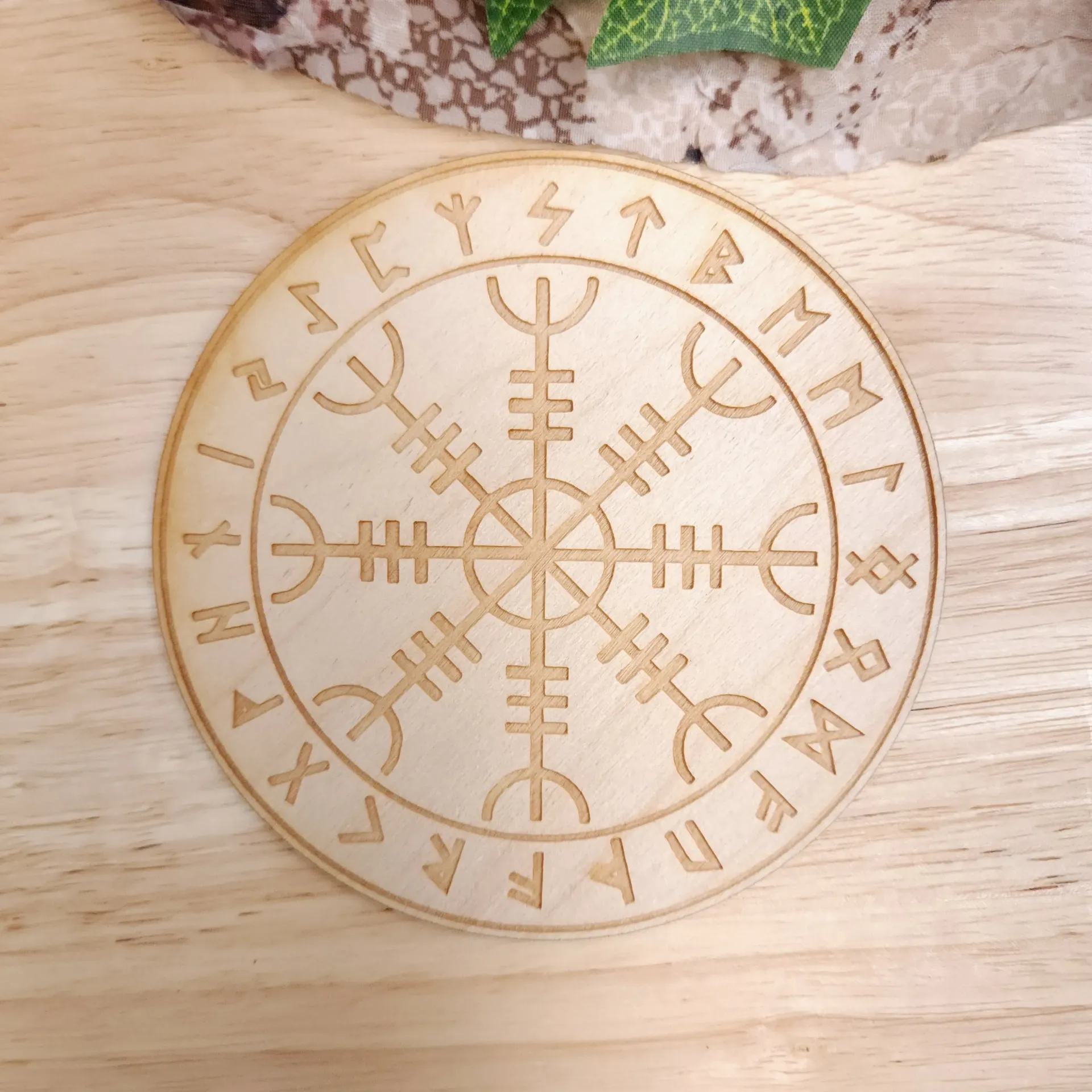
Quarter-inch plywood cut as a plain disc, with the whole face given over to engraving the eight-armed stave filling the inner field, a raised band, and a full ring of Elder Futhark characters running the outer margin. Four inches across, 0.05 lb. The line work is deep enough to read across a room and shallow enough that stones sit flat on it.
What you get
- One laser-etched wood grid board, Helm of Awe with Elder Futhark ring
- 4 inches diameter
- 1/4 inch thick
- 0.05 lb
- Three-layer cross-grained plywood
- Unfinished
- Stones, runes, and crystals are not included
About the form
Plywood is three thin sheets laminated with each layer's grain running crosswise to its neighbors, which is why a disc this thin stays flat instead of cupping the way a solid-wood round of the same dimensions would after a few seasons of Michigan humidity.
The design is burned rather than cut through. A laser at engraving power vaporizes a shallow channel along each line and scorches the walls of it, producing the amber edge on every stroke. That scorch lightens over months of light exposure. Grain varies sheet to sheet, so your board will not match the photograph.
Unfinished wood absorbs. Oils, wax, and water soak in permanently, and the board will patina where your hands rest. Wipe-on matte polyurethane or paste wax seals it if you want it pale; leave it bare if you want it to record its use. Bare wood also takes a wood-burner cleanly, if you intend to add your own marks.
Provenance and tradition
The name Ægishjálmr appears in the Poetic Edda. In Fáfnismál the dragon Fáfnir claims he wore the helm of awe over the hoard and that no one dared approach him because of it. What the Eddic sources describe there is a power or a possession rather than a diagram.
The drawn eight-armed figure comes from a later source: the Icelandic magical manuscripts, the galdrabækur, dating from roughly the seventeenth through the nineteenth centuries. The Huld manuscript, compiled by Geir Vigfússon at Akureyri in 1860, is the best-known of them. Those books give working instructions along with the staves, commonly to mark the sign on the forehead using lead, blood, or spit, for protection and to put fear into an adversary. No Viking Age archaeological find carries this figure. The word is old; the drawing is early modern Icelandic.
The arms are often read as stacked Algiz staves. That reading is a modern interpretive layer rather than anything the Icelandic sources state.
Who this is for
Heathen and Northern Tradition altars, rune casting surfaces, protective house wards, crystal grid layouts with a protection or courage focus, meditation focus, travel altars, and gifts for anyone working a Norse path. The Futhark ring makes it double as a quiet reference for anyone still learning the staves. Best with tumbled stones and small points rather than large specimens.