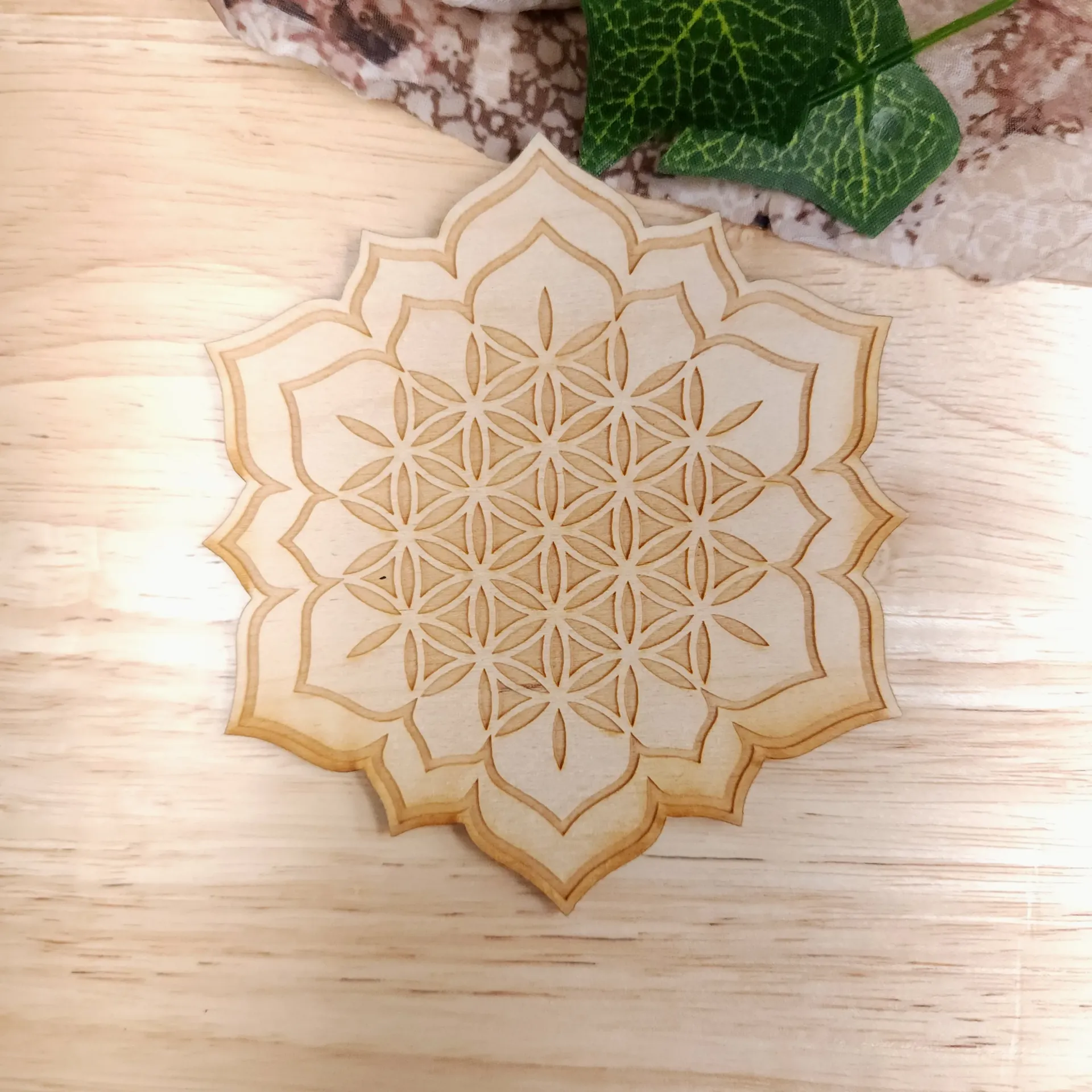
Quarter-inch plywood, cut so the outer boundary of the board is a layered lotus-petal frame rather than a plain circle. Inside it, the overlapping-circle lattice runs edge to edge across the full face at a fine engraving line. Four inches point to point, roughly two-thirds of an ounce, flat enough to stack and light enough to carry without noticing.
What you get
- One laser-etched wood crystal grid board, Flower of Life pattern in a lotus frame
- 4 inches point to point
- 1/4 inch thick
- 0.04 lb
- Three-layer cross-grained plywood
- Unfinished
- Stones and crystals are not included
About the form
Plywood is three thin sheets laminated with the grain of each running crosswise to its neighbors. The pattern is burned, not cut through. A laser at engraving power vaporizes a shallow channel along each line and scorches the channel walls, which produces the amber edge on every line. That scorch fades toward pale over months of light exposure.
Unfinished wood absorbs. Anointing oils, candle wax, and water will soak in and stay, and the board will pick up a patina where your hands rest most. Wipe-on matte polyurethane or paste wax will seal it if you want it to stay pale. Leave it bare if you would rather it darken and keep a record of use.
Provenance and tradition
The figure is built from circles of equal radius, each centered on the circumference of its neighbors, repeating outward in hexagonal packing. Every intersection produces the pointed oval called a vesica piscis, which is why the lattice looks like petals.
Worth knowing before you order: the canonical Flower of Life is nineteen complete circles held inside two concentric boundary rings. This board carries the extended lattice trimmed to the lotus outline, without the enclosing rings. It gives you a larger working field and a softer edge, but fewer than nineteen complete circles.
The overlapping-circle motif itself has a long documented life in ornamental design, including Roman floor mosaics, Islamic geometric design, medieval European decorative carving, and sketchbook studies by Leonardo. The often-repeated version at the Osirion at Abydos in Egypt is real, though the marks are red ochre applied to the stone rather than carved into it, and specialists generally read them as later additions rather than contemporaneous with the structure. The name "Flower of Life" attached to the pattern is a twentieth-century coinage from English-language sacred geometry writing.
Who this is for
Crystal grid layouts, altar decoration, a charging surface for a single stone, meditation focus, travel altars, and first-tool gifts. The lattice gives dozens of evenly spaced intersection points, which suits grids built from many small stones rather than a few large ones. Best with tumbled stones, chips, and small points.