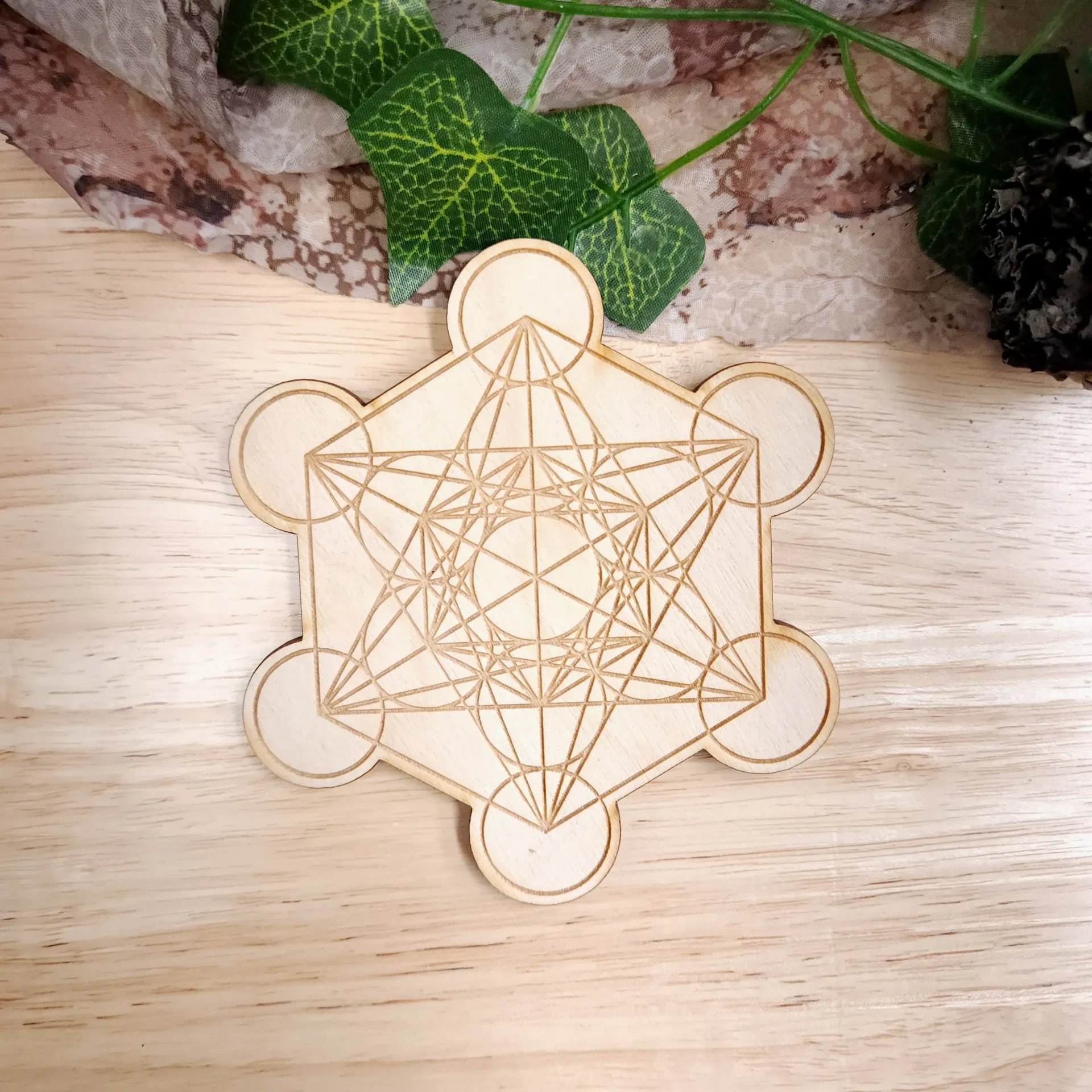
Three-ply plywood, cut to the outline of the figure rather than left as a round disc, so the six outer circles stand as physical lobes at the edge of the board. The whole piece weighs about two-thirds of an ounce. It will sit flat on an altar, travel in a bag without adding weight worth noticing, and hold a full arrangement of tumbled stones without flexing.
What you get
- One laser-etched wood crystal grid board, Metatron's Cube pattern
- 4 inches across at the widest points, lobe to lobe
- 0.04 lb
- Three-layer cross-grained plywood, 1/4" thick, unfinished
- Stones and crystals are not included
- Ready to use
About the form
Plywood means three thin layers of wood laminated with the grain of each layer running crosswise to its neighbors. That construction is doing real work on a board shaped like this one: a solid-wood disc cut into six narrow protruding lobes would want to split along the grain at the neck of each lobe, and cross-lamination removes that failure point. The board is stiff for its thickness because of it.
The pattern is burned rather than cut. A laser at engraving power vaporizes the top fraction of a millimeter of wood along each line, leaving a shallow channel with scorched walls, which is where the caramel color at the line edges comes from. Those channels are deep enough to read clearly and shallow enough that a tumbled stone or a small point sits stable across them.
Provenance and tradition
The figure is drawn from the Fruit of Life: thirteen circles in hexagonal packing, one at the center, six touching it, six more at the outer ring. Connect every circle's center to every other center and you get seventy-eight straight lines, which is the lattice you see across the face of the board.
Metatron himself comes out of Jewish mystical literature, principally the hekhalot texts and 3 Enoch, where the scribe Enoch is taken up and transformed into an angel of that name. Attaching the name to this particular diagram is a modern move, one that spread through English-language sacred geometry writing in the late twentieth century.
You will also see the claim that the figure contains all five Platonic solids. Two-dimensional projections of the cube, tetrahedron, and octahedron trace cleanly out of the line work. The dodecahedron and icosahedron require a fairly generous reading of which lines count.
Who this is for
Grid work, first and foremost: thirteen circles give you a center position, an inner ring of six, and an outer ring of six, which maps neatly onto a master stone with supporting stones. Also good for meditation focus, altar decoration, a charging surface for a single piece, a travel altar component, and a starter gift for anyone beginning to build a stone practice. The 4 inch size favors tumbled stones, chips, and small points over large specimens.